

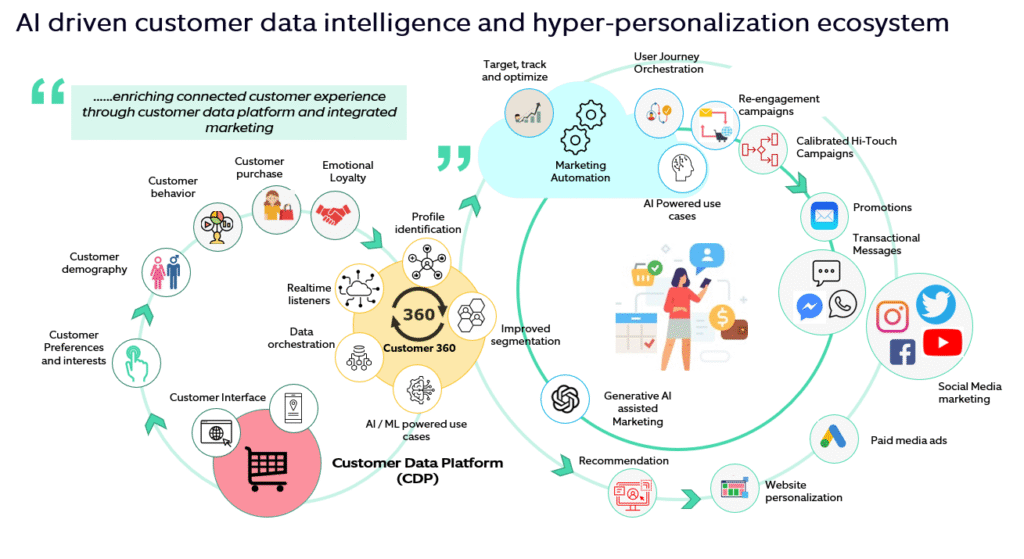
As a Principal Consultant, I bridge the gap between complex technology and enterprise business strategy. I specialize in driving organizational growth by helping Fortune 500 clients in CPG, Finance, Retail, and Automotive sectors monetize their data and maximize their MarTech investments.
My expertise spans architecting advanced Customer Data Platform (CDP) solutions, designing predictive AI/ML analytics frameworks, and orchestrating full-scale digital customer experience (CX) transformations.
Beyond delivery, I am deeply committed to organizational growth—fostering C-suite relationships, identifying new business development opportunities, and mentoring the next generation of strategists to deliver measurable bottom-line impact.
- MarTech & CDP Ecosystem Leadership
- Digital Transformation & CX Strategy
- AI & Data Science Strategy
- P&L and Practice Growth

How it works
Agentic AI Strategy
As AI models become commoditized, differentiation will not come from who has the best LLM. It will come from who can architect the most efficient, reliable, and secure Compound AI System around that LLM.
System Design Offers Higher ROI than Model Scaling
In many applications, scaling a model yields diminishing returns. For example, if a base LLM can solve complex coding problems 30% of the time, spending $10 million to train a larger model might only increase accuracy to 35%. However, if you build a system—where the LLM generates 100 possible solutions, a separate code-execution module tests them, and a smaller model scores the results—you can boost accuracy to 80% using today's models. System engineering is faster and cheaper than model training.
The Imperative of Dynamic Knowledge
A foundation model’s "knowledge" is frozen at the moment its training finishes. In the enterprise, data changes by the second. Compound systems solve this via Retrieval-Augmented Generation (RAG). By integrating a search retriever with an LLM, the system can access real-time inventory, live CRM data, and secure internal documents, overcoming the static limitations of the model.
Solving the Control and Trust Deficit
You cannot guarantee that a neural network won't hallucinate. This is a fatal flaw in regulated industries like finance or healthcare. Compound systems mitigate this by isolating the LLM. You can place "Guardrail Models" before and after the LLM to filter inputs and verify outputs. A system can be designed to automatically cite its sources, drastically increasing user trust.
Variable Performance and Cost Goals
GPT-4 is brilliant, but it is too expensive to use for routine, high-volume tasks (like tagging 10,000 support tickets). Conversely, for a highly complex legal analysis, it is too cheap—a user would gladly pay more compute for a better answer. Compound systems allow you to dynamically route tasks: sending easy questions to a cheap Small Language Model (SLM), and complex questions through a multi-step chain using a massive LLM.
Blog