

Every business leader wants an autonomous digital workforce, but right now, most are stuck in pilot purgatory.
Nearly two-thirds of global enterprises are currently experimenting with AI agents, yet fewer than 10% have successfully scaled them to deliver tangible ROI. What is killing the other 90%?
Bad data.
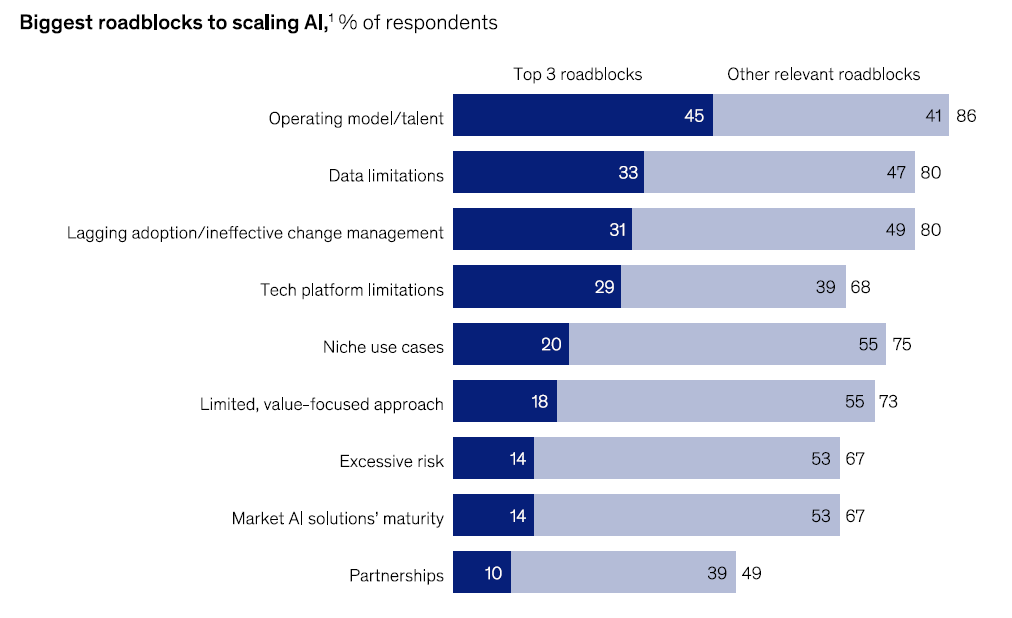
According to our Rewired research, eight out of ten companies point to underlying data limitations as the brick wall they keep hitting. In the past, engineering teams could occasionally muscle their way through fragmented, siloed databases to pull off a one-off analytics project or train a static model.
You cannot brute-force an autonomous agent.
Agents don’t just read data; they take action based on it. When you deploy an AI to act on your behalf, it requires pristine context. If your internal governance is inconsistent, the agent cannot securely enforce access controls, trace data lineage, or maintain the rigorous audit trails required for enterprise compliance. Ultimately, the dividing line between companies capturing real value from AI and those spinning their wheels comes down to a simple truth: you cannot scale a machine-led workforce on a human-era data architecture.
Automating complex business workflows unlocks the full potential of vertical use cases
Large Language Models (LLMs) gave us a massive leap forward in how we interact with data. Suddenly, we could synthesize massive documents and generate content just by chatting with a prompt box.
But for all their raw power, traditional LLMs have a fatal flaw: they are entirely reactive. They sit isolated from your core systems, suffering from digital amnesia the moment a session ends. Up to this point, generative AI has largely been a highly capable, but passive, assistant—great for boosting individual productivity, but useless unless a human is telling it exactly what to do.
AI agents change that dynamic completely. They represent the evolutionary leap from an AI that generates to an AI that executes.
Give an agent a high-level objective, and it doesn’t just write a response. It breaks that goal down into a checklist of sub-tasks. It navigates your enterprise systems, collaborates with human coworkers, and dynamically adjusts its plan if it hits a roadblock—all with minimal human hand-holding. It achieves this by taking the reasoning “brain” of an LLM and wiring it into an infrastructure that provides long-term memory, strategic planning, and direct API access to your tech stack.
This unlocks two massive shifts for the enterprise:
1. The Proactive Teammate (Horizontal Impact)
Agents transform our everyday, general-purpose copilots. Instead of a passive chat window waiting for a prompt, the AI becomes an active participant in your workday. It monitors your dashboards in the background, automatically triggers follow-up workflows, chases down open action items, and pushes relevant insights to your screen right when you need them.
2. Deep Process Automation (Vertical Impact)
While a proactive copilot is nice, the true breakthrough is happening deep within specific business operations. Agentic AI is now capable of running complex, multi-step workflows that require navigating multiple systems, coordinating with various departments, and making nuanced decisions along the way. We are no longer just automating the drafting of an email; we are automating the execution of the entire business process—a feat that first-generation AI simply couldn’t handle.
Data Limitation is first constraint for scaling AI in companies
Data is the backbone of agentic AI
You cannot run an autonomous digital workforce on a rigid data architecture.
Success in the agentic era requires a framework built for continuous, real-time decision-making. We are talking about modular, highly interoperable systems designed to give agents instant, secure access to the exact data they need to operate safely.
Early generative AI certainly exposed the need for basic data governance—things like access control, traceability, and data lineage. But agentic platforms multiply that operational pressure exponentially. A standard chatbot only reads data when prompted; an AI agent actively coordinates multiple models and data streams, executing complex tasks without waiting for a human to hit “enter.”
When machines are acting on your behalf around the clock, manual oversight is no longer an option. Scaling agentic AI requires more than just a written governance policy. It requires automated, airtight governance hardcoded directly into your infrastructure. If your data architecture cannot autonomously enforce access rules and perfectly track the lineage of an agent’s decisions, your deployment will never make it out of the pilot phase.
1. Treat Data Ingestion Like a Product
Stop building custom data pipelines for every new project. Instead, create a universal, standardized intake valve. Whether the information is a real-time transactional stream, a structured CRM table, or a messy, unstructured PDF, it should enter your ecosystem through a single, consistent process. The goal is “ingest once, use everywhere”—ensuring that the moment data hits your servers, it is clean, cataloged, and instantly readable by any agent that needs it.
2. Share Meaning, Not Just Data (The Semantic Layer)
An AI agent does not possess human intuition. If one database labels a metric “Revenue” and another calls it “Gross Sales,” a human can figure it out; an autonomous agent will fail. You must establish a robust semantic layer—a universal dictionary embedded in your architecture. This ensures that your traditional analytics dashboards, your machine learning models, and your AI agents all operate using the exact same definitions and business logic.
3. Unify Your Data Foundation
The era of siloed data architecture is over. You do not need one platform for your BI reporting and a separate, fragmented pipeline to feed your LLMs. You must converge your workloads into a single, unified data foundation. By building your data models once and sharing them across reports, predictive algorithms, and generative AI, you eliminate redundancies, reduce compute costs, and ensure absolute consistency across the enterprise.
4. Bake Trust in by Default
When machines are acting autonomously, you cannot bolt security onto the system after the fact. Access controls, data privacy masking, and AI governance must be hardcoded directly into the platform infrastructure. If an agent attempts to access restricted HR data or execute a workflow outside its authorization, the architecture itself should organically block the action. Trust must be automatic, not reliant on manual, human-in-the-loop approvals.
5. Expose Capabilities Through Stable APIs
Agents navigate the digital world entirely through application programming interfaces (APIs). If your internal APIs are brittle, undocumented, or constantly changing, your agents will break. You must treat your internal data endpoints and model access points as if they were commercial, public-facing products. By providing highly stable, version-controlled interfaces, your engineering teams can reliably build and scale multi-agent workflows without constant, frustrating rework.
6. Mandate Radical Observability
When human operators step back, your monitoring systems must step up. You need a highly sophisticated control room that makes every behavior visible and measurable. This means continuously tracking data drift, model latency, token costs, and accuracy rates in real-time. If a data pipeline stalls or an agent begins to hallucinate, your architecture must flag the anomaly milliseconds before it impacts a customer or an internal process.
7. Build a Controlled Execution Layer
You cannot just let autonomous agents run wild across your enterprise network. You need a centralized orchestration layer—a dedicated runtime environment where all AI agents are coordinated and managed. Think of this execution layer as the ultimate referee. It manages the handoffs between different specialized agents, limits resource consumption, and enforces strict enterprise guardrails to ensure no agent executes an action outside its defined scope.
Agent Types
As enterprise AI matures, we are seeing two distinct models of autonomous work take shape: the solo operator and the digital squad.
1. The Solo Operator (Single-Agent Workflows)
In this model, one highly capable agent tackles a process from start to finish. It moves sequentially—pulling a report from the CRM, analyzing the numbers, drafting an email, and updating a database.
2. The Digital Squad (Multi-Agent Workflows)
This is where things get complex. Instead of one generalist, you deploy a team of highly specialized agents that collaborate in real-time. They share context through enterprise knowledge graphs and rely on finely tuned data permissions to pass tasks back and forth, much like an assembly line of digital experts.
But here is the hard truth: both of these models share a fatal vulnerability. They are entirely dependent on clean, interoperable data. Without it, the illusion of autonomy shatters quickly.
If you feed a single agent fragmented or siloed data, it will inevitably make erratic, unpredictable decisions—like pulling an outdated price from a legacy system and confidently applying it to a new client contract.
In a multi-agent system, the stakes are exponentially higher. Bad data acts like a virus. If one specialized agent misinterprets a messy data point, it immediately passes that flawed logic to the rest of the squad. Coordination collapses, and a single hallucination quickly triggers a cascade of errors at machine speed.
Ultimately, building an autonomous workforce isn’t just about buying the smartest AI models; it’s about ensuring the data they run on is absolutely bulletproof.
How to prepare data for agentic AI
Transitioning to an agentic organization isn’t just a software upgrade; it’s a total operational reboot. If your underlying data strategy and human operating model are broken, the smartest AI in the world won’t save you.
Building a foundation that actually scales requires a coordinated shift across your strategy, your technology, and your people. Here is the four-step playbook to get there:
1. Pick Your Targets (Don’t Boil the Ocean)
You cannot “agentify” your entire enterprise overnight. Start by isolating a handful of high-value, end-to-end workflows where machine autonomy will actually move the needle. Treat these initial projects like highly focused data products. Prioritize them based on three strict metrics: pure value potential, technical feasibility, and strategic fit. Prove the ROI here first before you try to scale out to the rest of the business.
2. Modernize for Modularity
There is a massive temptation right now to use AI as a band-aid for a sloppy, legacy data architecture. It never works. However, you also don’t need to burn your existing tech stack to the ground. Instead, modernize your current platforms with a strict focus on interoperability and automated governance. You need a modular architecture—one where individual data components can be easily swapped out as new, smarter AI models inevitably hit the market.
3. Shift to Continuous Data Quality
Periodic, batch data clean-ups are a relic of the past. In an agentic world, bad data leads to instantaneous, automated bad decisions. You must shift to continuous, real-time quality management. This means establishing ruthless standards for accuracy, data lineage, and governance across all your inputs—whether that information is neatly structured in a CRM, buried in an unstructured PDF, or generated autonomously by another AI agent.
4. Redesign the Human Operating Model
Deploying an AI workforce forces you to fundamentally rethink human work. The days of your people acting as manual executors are ending. Instead, your human talent must pivot to strategy, supervision, and orchestration. But to make this hybrid human-agent environment function safely at scale, you need an airtight governance model. You must clearly define exactly where the machine’s autonomous authority ends and human oversight begins.
Identify high-impact workflows to'agentify'
The fastest way to generate real value from agentic AI isn’t by ripping out your entire operating model on day one. It’s about performing targeted surgery.
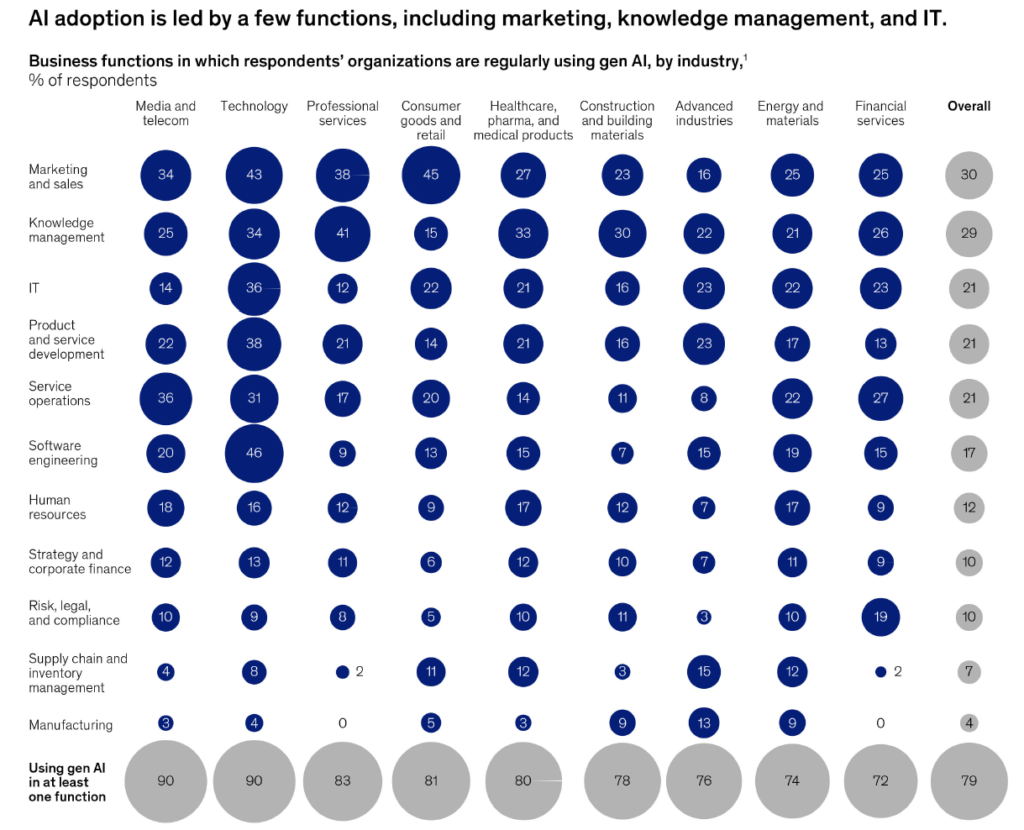
You have to deliberately rewire a few critical workflows in high-impact areas. Look at domains where heavy friction meets massive opportunity—like marketing production or complex knowledge management. The goal isn’t just to automate a few isolated tasks. It’s to pinpoint the exact bottlenecks where handing the keys to an autonomous machine will fundamentally alter your bottom line.
To get there, you have to map the work. Break your end-to-end processes down to the studs. Identify exactly where an agent can step in, and more importantly, map the precise data that agent will need to execute the job safely without human intervention.
This exercise gives you a ruthless filter. Instead of chasing flashy AI trends, you end up with a prioritized roadmap built on two non-negotiable metrics: pure value potential and actual technical feasibility.
Modernize each layer of the data architecture for agents
You do not need to burn your existing data stack to the ground to prepare for the agentic era. You just need to rewire it.
Think about a typical omnichannel retail experience. Historically, product inventory and purchase histories lived in isolated silos. When a customer moved from the website, to the mobile app, to a physical store, their context was lost, resulting in clunky, disjointed service. An agent-ready architecture solves this by connecting these fractured systems, giving your autonomous workforce access to a single, continuous thread of truth.
Moving from a fragmented legacy system to an interoperable, agent-driven engine requires modernizing six distinct layers of your architecture:
1. The Data Source Layer: Automated Ingestion
This is your intake valve. Whether it’s a structured transaction log or an unstructured customer support transcript, data is continuously ingested and transformed here. But in an agentic world, governance must travel with the data. Quality checks, security protocols, and lineage tracking can no longer be periodic, manual reviews—they must be hardcoded directly into the pipeline. This layer cleans and enriches the data, adding the baseline business context an agent needs to act reliably.
2. The Data Platform Layer: The Connective Tissue
This layer orchestrates real-time synchronization across your enterprise. If a customer updates a preference in your app, the platform ensures the AI agent handling their support ticket knows about it instantly. To manage unstructured data (like images or PDFs), this layer heavily utilizes vector databases, making content searchable by its actual meaning rather than rigid keywords. By embedding interoperability protocols here, multiple AI agents can securely coordinate tasks—like updating inventory and processing payments simultaneously—without dropping the baton or losing the audit trail.
3. The Semantic Layer: The Universal Translator
Raw data is useless to an agent if it lacks context. The semantic layer sits between your databases and your AI, codifying business logic into a machine-readable format. Instead of treating data as disconnected spreadsheets, this layer uses ontologies and knowledge graphs to map how different metrics relate to the real world. Without this shared vocabulary, two specialized agents might interpret the exact same data point differently, creating a cascade of operational errors.
4. The Data Products Layer: Reusable Assets
Stop treating data as a chaotic byproduct and start treating it as a curated product. This layer packages clean, contextualized data with clear ownership and quality standards. By creating these reusable “data products,” you give your AI agents a trustworthy, pre-vetted menu of generative and predictive insights they can pull from at scale. Crucially, this layer also observes how agents use the data, creating a feedback loop to continuously improve the upstream models.
5. The Data Consumption Layer: The Point of Execution
This is where intelligence meets action. Sitting at the top of the stack, this layer delivers APIs, retrieval interfaces, and dynamic context directly into your workflows. Instead of relying on rigid, pre-defined search queries, orchestration engines dynamically assemble the exact context an agent needs on the fly. Furthermore, the work the agents do here—generating new labels, identifying usage patterns, or inferring user intent—is captured and fed back into the system to train future models.
6. Governance and Access Controls: The AI Guardrails
You cannot give an autonomous workforce unrestricted access to your enterprise. A modern “medallion” architecture progressively curates data from its raw state to an “agent-ready” form, preserving an unbreakable audit trail along the way. To enforce this, enterprises must deploy an AI gateway. Think of it as a strict digital bouncer that dictates exactly which agents can access specific datasets, enforces usage policies in real-time, and logs every single prompt and response for absolute compliance.
Ensure that data quality is in place
In the agentic era, pristine data is no longer just an IT goal—it is your deepest competitive moat.
Running massive foundation models is incredibly expensive when you factor in the sheer computing power, continuous fine-tuning, and heavy governance required. But if your internal data is meticulously curated, you hold a strategic cheat code. Instead of relying on massive, generalized AI, you can train smaller, domain-specific models on your own proprietary data. These targeted models are not only radically cheaper to operate, but they are also far more resilient and compliant with enterprise standards.
To unlock this, you have to rethink how you handle your data from the ground up:
1. Tame the Unstructured Mess
Historically, unstructured data—like emails, PDFs, and images—has been dumped into digital lakes and ignored. You can no longer afford to do that. To make this data usable for AI, it must be aggressively structured through rigorous tagging, vector embeddings, and knowledge graphs. If you want an autonomous agent to understand nuance and relationships, you must hold your unstructured content to the exact same standard of quality as your structured databases.
2. Shift to Real-Time Quality Control
The days of the “monthly database cleanup” are over. In an agent-driven world, bad data leads to instantaneous, automated mistakes at scale. Organizations must shift to continuous, real-time quality monitoring. By using AI to automatically validate inputs and flag anomalies the second they occur, you prevent minor errors from cascading across your workflows. Crucially, robust metadata management ensures that when an agent makes a decision, you have the exact lineage needed to trace its logic and justify the action.
3. Govern the Machine’s Output
Finally, remember that agents don’t just consume data—they actively create it. When an AI agent interacts with an API, updates a system of record, or generates a new insight, that output cannot bypass enterprise quality control. Any data written by a machine must be subjected to the exact same rigorous standards of reconciliation and lineage as human-generated work. By embedding strict, shared definitions directly into automated quality checks, you ensure your digital workforce never strays from a foundation of absolute truth.
Build an operating and governance model for agentic AI
When you hand the keys to an autonomous machine, governance is no longer just a compliance exercise—it becomes your steering wheel.
As you scale agentic systems, you need explicit, hardcoded policies that dictate exactly what an agent can touch, what it can execute, and precisely when it must stop and ask a human for permission. Crucially, agents don’t get to invent their own rules. They must operate strictly within the same data quality and governance standards you already enforce for your human workforce. The only difference is that for an AI, these access checks must be evaluated automatically, in milliseconds, based on the agent’s specific role.
To manage this safely, organizations are completely rethinking their approach to oversight across four key areas:
1. AI Policing AI (The Guardrail Agents)
How do you monitor a machine working at machine speed? You build another machine. We are seeing the rapid rise of “guardrail agents”—AI systems deployed specifically to watch other AI. For example, a creative compliance agent can autonomously scan thousands of AI-generated marketing assets, instantly catching brand misrepresentations or legal violations and triggering corrective actions before an image ever goes public.
2. Managing the Machine Lifecycle
IT and risk teams must treat AI agents with the same operational rigor they apply to human employees. That means issuing specific digital credentials, monitoring daily performance, and enforcing automated policy checks. Every action, data pull, and decision an agent makes must be captured through built-in telemetry. If something breaks, you need a flawless, instantaneous audit trail to see exactly why the agent made that specific choice.
3. The Federated Accountability Model
If an agent makes a costly mistake, who is responsible? Scaling this technology requires crystal-clear lines of accountability. Leading enterprises are adopting a “federated” model to solve this. The business units own the day-to-day workflow and the specific business logic (the ontologies). Meanwhile, central IT and data teams maintain the shared platform, the security guardrails, and the overarching oversight. It is the perfect balance between domain agility and enterprise-wide safety.
The Bottom Line
In the agentic age, your underlying data foundation dictates your competitive ceiling.
Despite the massive promise of autonomous workflows, most organizations are still tripping over their own tangled, siloed systems, unable to give their digital agents the clean, governable access they require. The AI technology is ready. The protocols are built. The time has come to completely rewire your data infrastructure—or risk being left behind in a purely human-speed economy.