


The first wave of generative AI was characterized by “single-model, single-use” applications. These systems were contained, deterministic, and largely isolated behind static API endpoints. However, as we enter the second wave, the Agentic Era, the limitations of this approach have become acute.
Enterprise AI is shifting from passive tools to active participants. These autonomous agents discover tools dynamically, share persistent memory, and communicate via standardized protocols like Model Context Protocol (MCP) and Agent-to-Agent (A2A) interfaces. This transition demands a fundamental re-architecting of the enterprise stack.
To thrive, organizations must converge around three critical layers of Agentic AI architecture: Orchestration, Platform Services, and the Cognitive Data Foundation.
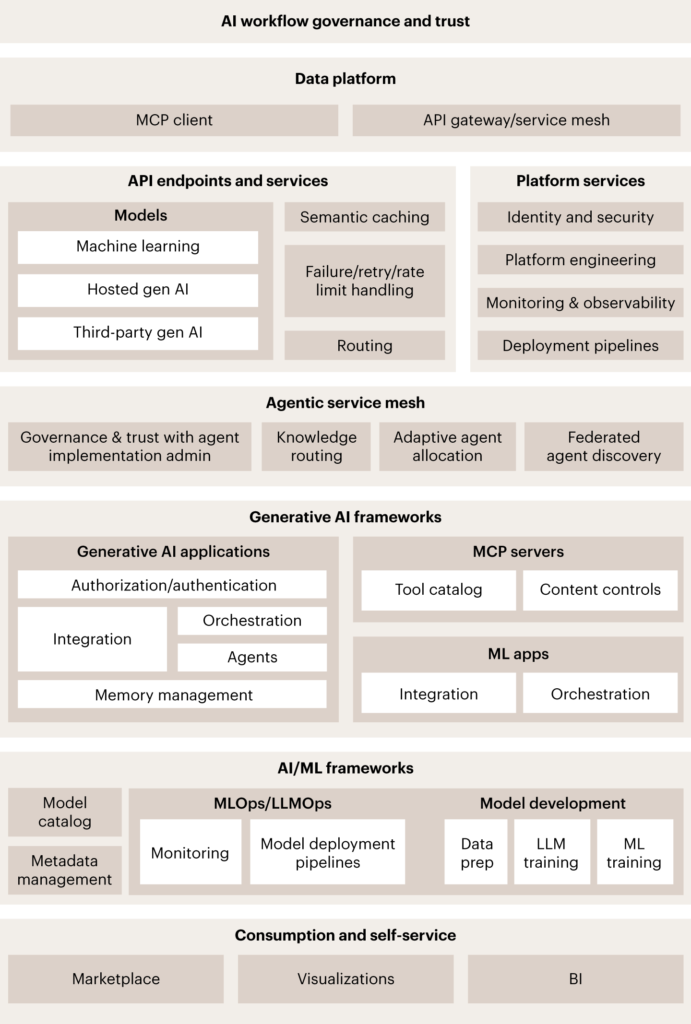
I. The Application and Orchestration Layer: The Command Center
At the top of the stack resides the Application and Orchestration Layer. In a multi-agent environment, this layer serves as the “Command Center,” directing the symphony of models and tools required to achieve a high-level business objective.
Legacy architectures relied on fixed ETL pipelines and hard-coded logic. Agentic systems, conversely, require Dynamic Orchestration.
Key Capabilities:
- Multistep Control Flow: Managing the sequence of tasks, including parallel execution, retries, and time-out handling.
- Context Handoffs: Ensuring that as Task A finishes, the context (variables, progress, decisions) is passed seamlessly to the agent responsible for Task B.
- Sandboxed Execution: Enabling agents to generate and execute code in isolated environments to solve complex data problems without risking core system integrity.
Example in Action: The Global Supply Chain Agent Imagine a port strike disrupts a critical shipment. A legacy system might merely flag a delay. An Agentic Orchestrator perceives the event, triggers a “Logistics Specialist Agent” to find alternative routes via an MCP tool, invokes a “Financial Impact Agent” to calculate cost deltas, and finally presents a pre-negotiated alternative to a human manager for final approval.
II. The Agentic Service Mesh: Managing the Non-Human Workforce
The second layer is the Agentic Service Mesh and Platform Services. As enterprises deploy hundreds of specialized agents, the risk of “Agent Sprawl” becomes a strategic threat. This layer provides the connective tissue and the governance “guardrails” that prevent autonomous systems from operating in a vacuum.
Key Capabilities:
- Federated Agent Discovery: A centralized registry where agents can find and “hire” other agents based on their governed skills and entitlements.
- Identity for Non-Human Principals: Traditional identity management assumes a human is at the keyboard. Agentic architecture requires Contextual Least-Privilege permissions for non-human identities, ensuring an agent only accesses the specific data needed for its current task.
- Runtime Guardrails: Monitoring for prompt-injection, hallucination patterns, and bias in real-time. If an agent’s behavior regresses, the platform triggers an automated rollback based on defined Service Level Objectives (SLOs).
Strategic Imperative: Organizations must treat Memory Management as first-class infrastructure. Agents require both short-term session memory and long-term persistent memory to learn from past interactions and provide hyper-personalized outcomes.
III. The Data and Knowledge Layer: The Cognitive Foundation
The most sophisticated orchestrator is useless without high-quality, real-time data. The Data and Knowledge Layer unifies structured, unstructured, and streaming data into a single, governed source of truth.
McKinsey research suggests that data quality is the “make-or-break” factor for agentic scaling. This layer moves beyond stale data snapshots toward Real-Time Streaming Pipelines.
Key Capabilities:
- Multi-Modal Storage: Unifying relational databases with Vector and Graph stores to allow agents to perform complex semantic searches and understand relationship hierarchies.
- Data Contracts & Lineage: Enforcing strict governance at the pipeline level. If a data source changes its schema, the agentic system must be alerted to prevent reasoning failures.
- Federated Data Governance: Implementing masking, retention, and cross-domain access controls directly into the ingest process.
Example in Action: The “Digital Concierge” in Wealth Management To provide a proactive investment recommendation, an agent doesn’t just need the client’s current balance (Structured). It needs the sentiment from their last three meetings (Unstructured/Graph) and the real-time market volatility for their specific asset classes (Streaming). This layer provides that unified view instantly.
IV. The Analytics and Insight Layer: Ensuring Traceability
Governance cannot be an afterthought; it must be “embedded” rather than “tacked on.” The Analytics and Insight Layer provides the transparency required to build trust in autonomous systems.
Unlike traditional software where we audit code, in Agentic AI, we audit Reasoning Paths.
- Full Reasoning-Path Traceability: Capturing every step from the initial user prompt to the final tool invocation.
- Explainability: Enabling teams to ask, “Why did the agent decide to cancel this order?” and receiving a step-by-step logic audit.
- Alignment Monitoring: Continuously measuring behavioral drift to ensure the “autonomous fleet” remains aligned with corporate policy and ethical standards.
The Road Ahead: Transitioning to the Agentic Enterprise
Modernizing the enterprise architecture for the Agentic Era is not merely a technical upgrade; it is a strategic repositioning. Organizations that successfully converge these three layers, Orchestration, Service Mesh, and Data Foundation, will move from a collection of independent AI components to a shared, enterprise-wide capability.
The CEO Agenda:
- Audit the “Identity Gap”: Can your security stack handle thousands of non-human identities with variable permissions?
- Move to “Living Specs”: Transition development from archaeological code-reading to spec-driven agentic development.
- Embed Governance: Ensure that control points, auditability, and oversight become part of normal operations, rather than a final gate.
Architecture alone isn’t enough, but without it, the promise of Agentic AI remains an unscalable pilot. The time to build the foundation is now.