

For the past two years, the enterprise has been playing with fire. We’ve seen a thousand “Proof of Concepts” (PoCs) and a million chatbots. But as any seasoned CTO knows, a successful pilot is not a successful product.
The year 2026 marks a historic pivot. We are witnessing the end of superficial AI integration and the rise of the Agent Foundry. To survive this shift, organizations must move from a “software-centric” mindset to an “infrastructure-first” mandate. We are no longer just writing code; we are building a factory for autonomous thought.
The Agent Factory: A Six-Stage Industrial Process
Scaling AI across a global enterprise requires more than just a large language model (LLM); it requires a repeatable, industrial process. This is the “Agent Factory”, a sequence that ensures every autonomous worker is safe, reliable, and ROI-positive.
1. Workflow Codification
The process does not begin with a model; it begins with the work. You cannot automate what you do not understand. Organizations must map every process step and handoff, cataloging edge cases with surgical precision. The quality of your agent is strictly bounded by your understanding of the underlying workflow.
2. Hard Prerequisites
Technical readiness is a vanity metric; operational readiness is what matters. A CTO’s most important job in 2026 is securing named Subject Matter Experts (SMEs) and business leaders who own the results. Without human ownership, scaling is impossible.
3. The Agent Contract
If you cannot write the contract, the agent is not ready to be built. Every agent requires a clearly defined “contract” that specifies:
- Trigger Conditions: When does the agent wake up?
- Typed Input/Output Schemas: Exactly what data goes in and comes out?
- Autonomy Boundaries: Where is the agent forbidden from going?
4. Modular Orchestration
The days of the “monolithic” AI system are dead. We are moving toward ecosystems of specialized agents. By utilizing deterministic orchestration for the “boring” parts of a process and only calling on LLM reasoning when flexibility is required, we ensure stability at scale.
5. Rigorous Evaluation
Trust is earned through shadow testing. Before full deployment, agents must undergo rigorous evaluation against human-calibrated baselines. We don’t just ask if the AI is “good”; we ask if it outperforms its human counterpart in a “living” evaluation set.
6. Control Tower Governance
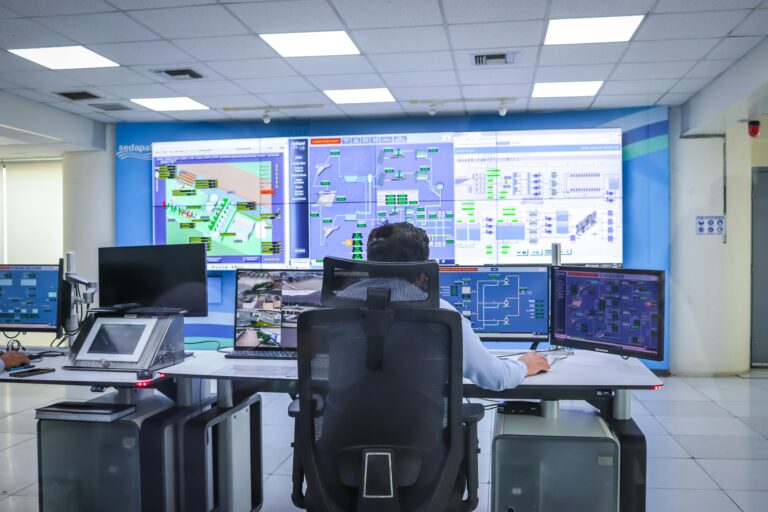
Autonomy without visibility is a liability. Every agent factory must have a Control Tower, a centralized command plane providing visibility and, most importantly, “kill switches” to halt inappropriate actions in real-time.
The Architectural Shift: Spec-Driven Agentic Development
We are moving away from traditional development toward Spec-Driven Development. In this paradigm, executable specifications, written in Markdown or specialized Domain-Specific Languages (DSLs), become the “Source of Truth.”
Component Traditional Development Spec-Driven Agentic Development Knowledge TransferArchaeological (reading legacy code) Architectural (reading living specs) Code Review Syntax and style focused Logical and architectural validation Integration Late-stage testing failures Early-stage contract alignment Documentation Decays immediately Self-maintaining (specs drive code)
This shift reduces the “archaeological work” of reverse-engineering code when developers depart. Instead of guessing why a system acts a certain way, we read the Living Specs.
Taming Agent Sprawl: The AI Agent Control Tower
As enterprises deploy hundreds, then thousands, of specialized agents, we face a new threat: Agent Sprawl. Unmanaged, untracked, and potentially conflicting autonomous systems can create organizational chaos.
The solution is the AI Agent Control Tower. This centralized command plane manages the entire lifecycle of the organization’s autonomous fleet through four key pillars:
- Centralized Visibility: A real-time registry of every agent, detailing its version, location, and operational status. No more “ghost agents” running on forgotten servers.
- Behavioral Drift Detection: Continuous analysis of agent output against “golden samples.” The Control Tower identifies subtle shifts in decision pathways before they become catastrophic failures.
- Financial Control: Usage metering and cost attribution. We must prevent “cost blackouts” and runaway token consumption by attributing every cent of spend to a specific department or agent.
- Runtime Guardrails: Security policies that operate independently of the agent’s reasoning layer. Even if the agent “wants” to take a risky action, the Control Tower prevents the execution at the infrastructure level.
🚀 The Path Forward
The transition from “AI Pilots” to Industrial Intelligence is the defining challenge of 2026. The companies that win will not be those with the largest models, but those with the most robust Foundries.
Stop building chatbots. Start building the factory.