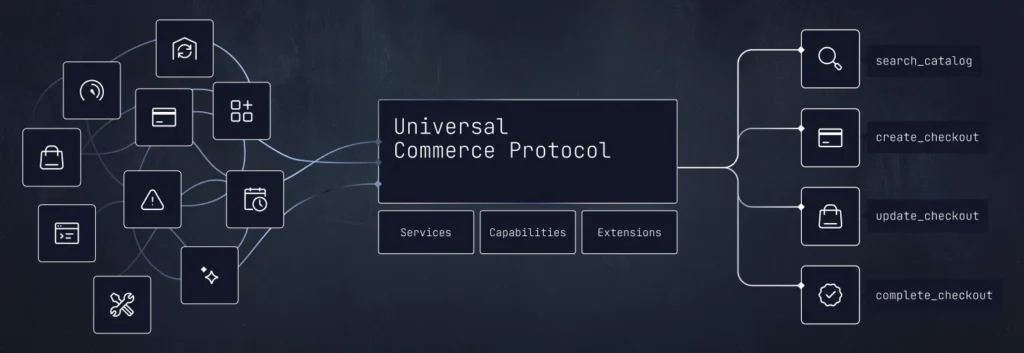



The Problem: The Hallucination-Liability Paradox
Imagine a customer typing: “I need a charger for my Dell XPS 15 that won’t overheat.”
If you route this directly to a standard LLM hooked up to a search API, you are playing Russian Roulette with your GMV and legal department. The LLM might find a heavily reviewed 30W charger, ignoring that an XPS 15 requires at least 130W (or 60W for trickle charging). The result? The charger overheats, the customer is furious, and your Return Merchandise Authorization (RMA) rates skyrocket.
The image provided solves this through a brilliant paradigm: “Never Smart but Unsafe.” It enforces a hard decoupling between semantic translation (Intelligence), catalog retrieval (Determinism), and final evaluation (Judgment).
Let’s break down the architecture component by component.
1. The Orchestrator:nbsp;RouterAgentnbsp;and Sharednbsp;SessionState
At the highest level, the system is governed by a Root Agent (Orchestrator). It acts as the DAG (Directed Acyclic Graph) manager, routing the user input through a predefined, multi-agent pipeline.
Crucially, it relies on a SessionState (Shared Memory). In multi-agent orchestration (akin to LangGraph or AutoGen architectures), state management is everything. Instead of passing massive context windows back and forth, which bloats the KV-cache and spikes latency/cost, agents read from and write to specific keys in a shared JSON state:
- search_params: The hard mathematical constraints.
- valid_candidates: The deterministic output.
- final_decision: The ultimate curated result.
2. Phase 1: Vibes → Math (The Translator)
Component: LlmAgent | Intelligence: HIGH (Gemini 3.0 Flash)
Human intent is messy; enterprise databases are rigid. The role of the Translator Agent is to act as a semantic parser. It takes unstructured “vibes” (“Dell XPS 15”, “won’t overheat”) and maps them into a strict, programmatic schema.
Model Under the Hood: Why specify Gemini 3.0 Flash? In commerce, latency is directly correlated to cart abandonment. Flash architectures utilize highly optimized attention mechanisms (like Multi-Query Attention or Ring Attention) to provide near-instantaneous Time-To-First-Token (TTFT).
During this phase, the model’s self-attention heads map the semantic tokens of “Dell XPS 15” to its parametric memory of hardware specifications, realizing that the device requires a USB-C connector and a minimum wattage.
To ensure the output is strictly valid for the next agent, we employ Constrained Decoding (e.g., using JSON-mode or grammar-based sampling). The logits are masked so the model physically cannot output anything other than a valid JSON schema:
3. Phase 2: Math → Filters (The Executor)
Component: SequentialAgent | Intelligence: ZERO (Deterministic)
Here is where the architecture shines. Once we have the mathematical constraints, we turn the AI off. We shift from probabilistic generation to deterministic execution. The SequentialAgent executes a strict pipeline against the Universal Catalog Platform (UCP):
- UCP Search (1000 → 50): Standard vector or BM25 lexical search applying the min_watts=60 and connector=”USB-C” filters.
- Check Stock (50 → 5): A real-time API call to the inventory management system (IMS). AI should never guess inventory.
- Safety (5 → 2): A compliance check against product recall databases or UL-certification metadata.
Architectural Takeaway: The “Executor” represents the funnel of truth. By reducing the candidate pool from 1000 to 2 strictly safe, in-stock items, we mathematically eliminate the possibility of the final AI agent hallucinating a dangerous or out-of-stock product.
The output ([Anker 65W, Generic 65W]) is written to SessionState.valid_candidates.
4. Phase 3: Judgment → Choice (The Judge)
Component: LlmAgent | Intelligence: HIGH (Gemini 3.0 Flash)
Now that we have a mathematically guaranteed “Safe Set,” we turn the intelligence back on. The Judge Agent is fed the user’s original soft constraints (“won’t overheat”) alongside the rich metadata and user reviews of the two surviving candidates.
Model Under the Hood: The LLM now executes a reasoning loop (similar to an internal ReAct trace). Its attention layers focus on the sentiment within the product reviews of the Anker vs. the Generic brand. It detects semantic clusters around “heat,” “melt,” or “warm” in the Generic brand’s reviews, while recognizing the Anker product’s superior thermal management mentions.
Because the candidate pool is locked to the “Safe Set”, the LLM is free to exercise maximum semantic reasoning without the risk of breaking business logic. It confidently outputs: “Anker 65W – Better reviews regarding thermal management,” pushing the final output to SessionState.final_decision.
The Commerce Impact: Why This Architecture Wins
Implementing this Vibes → Math → Filters → Choice pattern yields massive ROI for enterprise retailers:
- Zero-Hallucination Liability: By sandwiching a deterministic API executor between two LLM reasoning steps, you completely eradicate the risk of recommending incompatible or recalled products.
- Increased Conversion Rate (CVR): Customers using complex, long-tail queries (“charger that won’t overheat”) normally hit “Zero Search Results” on traditional keyword engines. This architecture processes complex intent perfectly, capturing high-intent revenue.
- Reduced Token Cost & Latency: Instead of feeding a massive database into an LLM via RAG (which is slow and expensive), the heavy lifting of filtering (1000 down to 2) is done by cheap, fast SQL/vector operations. The final Judge LLM only processes the tokens of 2 products, optimizing the economics of your AI deployment.
The ultimate takeaway: Do not build commerce agents that guess. Build commerce agents that translate, strictly filter, and then judge. Structure for safety; intelligence for smarts.