


In the traditional world of e-commerce, we optimized for one type of visitor: a human using a browser. We built navigation bars, filters, and visual merchandising to help them find what they needed.
But in 2026, the “shopper” is changing. A significant portion of your traffic is no longer a human browsing; it is an AI Agent executing a mission.
To win in this new era, retailers must stop treating all AI interactions the same. According to recent market analysis, successful strategies depend entirely on two variables: Shopping Intent (Exploratory vs. Directed) and Purchase Complexity (Simple vs. Considered).
This creates a 2×2 matrix that defines the future of retail. Here is what shoppers want in each quadrant, and how retailers must respond to survive.
Part 1: The 4 Quadrants of Agentic Shopping
Shoppers delegate tasks to AI based on how much help they need (Intent) and how risky the purchase feels (Complexity). This creates four distinct “Agentic Archetypes.”
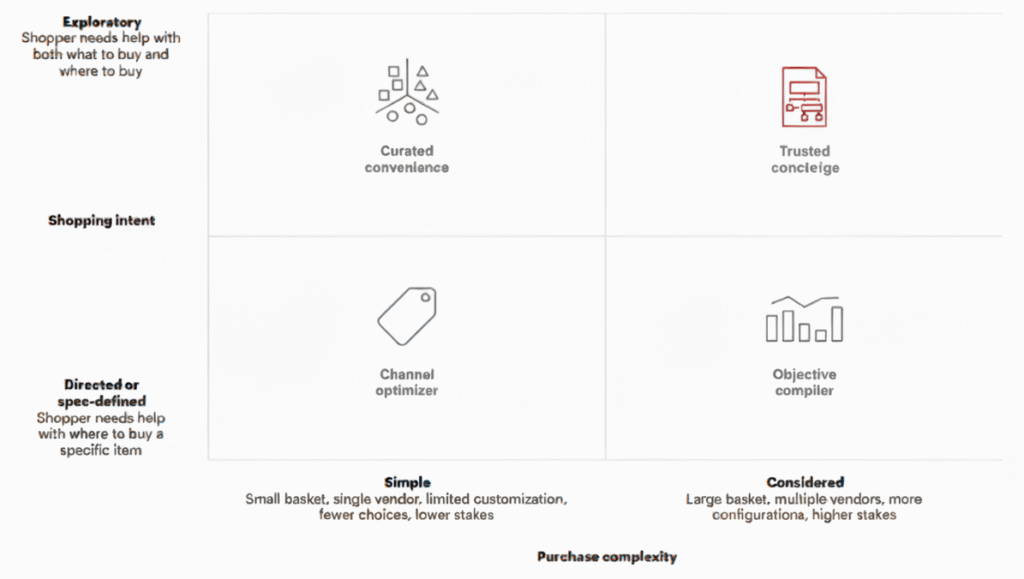
1. Curated Convenience (Exploratory + Simple)
- The Mission: “Help me plan my holiday ski vacation for my family of five for under $5,000.”
- The Shopper’s Need: Light curation. They don’t know exactly what they want, but the stakes are low (e.g., small gifts, party supplies).
- The Agent’s Role: The Tastemaker. The agent suggests items based on trends or vague prompts (“gift for an 8-year-old who loves rockets”).
- The Retailer Risk: High. If you aren’t in the agent’s recommendation set, you don’t exist. The agent disrupts both brands and retailers here.
2. Trusted Concierge (Exploratory + Considered)
- The Mission: “Help me plan a full kitchen renovation.”
- The Shopper’s Need: Deep planning and service bundling. The stakes are high, and the purchase involves multiple vendors.
- The Agent’s Role: The Project Manager. It bundles services, products, and logistics.
- The Trust Factor: Shoppers are hesitant to let AI fully automate this yet. Trust needs to grow before full autonomy occurs.
3. Channel Optimizer (Directed + Simple)
- The Mission: “Find the cheapest four-pack of Energizer AA batteries I can get by tomorrow.”
- The Shopper’s Need: Speed and Price. They know exactly what they want.
- The Agent’s Role: The Price-Checker. It ruthlessly compares price and availability across the web.
- The Retailer Risk: Extreme. This is most disruptive to multi-brand retailers. If you aren’t the cheapest or fastest, the agent filters you out immediately.
4. Objective Compiler (Directed + Considered)
- The Mission: “Find a 55-inch TV that has three HDMI ports and works with a Sonos system.”
- The Shopper’s Need: Validation. They have specific specs and need to confirm compatibility.
- The Agent’s Role: The Researcher. It configures, compares, and validates complex specs.
- The Opportunity: AI provides massive time savings here, making this a high-value area for retailers who provide structured, detailed data.
Part 2: How Retailers Should Respond (The Strategy)
Retailers cannot use a one-size-fits-all strategy. Depending on where your products fall in the matrix above, you must adopt one of two strategic postures: Build or Participate.
Strategy A: Build Owned Agentic Capabilities
- Best for: Trusted Concierge and Objective Compiler missions (Complex/Considered).
- The Play: If you have unique, proprietary data or deep domain expertise, build your own agent.
- The “Moat”: Generalist agents (like ChatGPT) are broad but shallow. A retailer-specific agent can beat them on depth.
- Real-World Example: Home Depot’s “Magic Apron.” Home Depot leveraged its project expertise and proprietary data to create a specialized companion. It doesn’t just sell a drill; it guides the user through the project. This specialized support draws customers onto the site, protecting the direct relationship.
Strategy B: Participate Strategically
- Best for: Channel Optimizer and Curated Convenience missions (Simple/Commoditized).
- The Play: Don’t fight the tide. Collaborate with the big agents (OpenAI, Google, Perplexity).
- The Tactic: Partner early to influence the rules of engagement. Negotiate to retain ownership of customer data and ensure the checkout happens through your gateway.
- Real-World Example: Walmart, Etsy, and Shopify. These giants partnered with OpenAI to utilize ChatGPT’s Instant Checkout. By integrating, they ensure they remain the fulfillment engine even if the discovery happens off-platform.
Part 3: The Technical Must-Dos for the Agentic Age
Regardless of strategy, your infrastructure must change. An agent cannot buy from you if it cannot “read” you.
1. Optimize for “Agent SEO” (Review Density) Recent research from Columbia and Yale indicates that AI agents heavily weigh review counts and average ratings when selecting products.
- Action: You must optimize your review collection strategy. High-quality, verified reviews are no longer just social proof for humans; they are ranking signals for bots.
2. Build a “Headless” Bot Website Agents struggle with visual websites designed for humans (pop-ups, slow load times, complex navigation).
- Action: Build a “Headless” or “Bot” version of your site. This is a streamlined API or text-based interface designed specifically for Agent-to-Agent commerce. It improves the speed and control over how external agents access your inventory, prices, and descriptions.
3. Data Structure is King For the Objective Compiler, unstructured data is a dealbreaker.
- Action: Ensure your product catalog is marked up with rigorous schema. If an agent asks, “Does this TV have HDMI 2.1?”, your data must explicitly say “Yes” in a machine-readable format, or you will lose the sale to a competitor who does.
Conclusion
The era of the “Average Shopper” is over. We now have Human Shoppers (driven by emotion and experience) and Agent Shoppers (driven by logic and data).
Winning retailers will be those who can serve the human with a concierge experience (Strategy A) while simultaneously exposing their data to the ruthless efficiency of the agent ecosystem (Strategy B).
Which quadrant does your business live in?