

To build a functioning enterprise agent, one that doesn’t just “chat” but actually works, you cannot rely on a single GPT-4 class model. You need a team. Just as you wouldn’t hire a Poet to run your Accounting software, you shouldn’t use a Generative Transformer to click buttons in SAP.
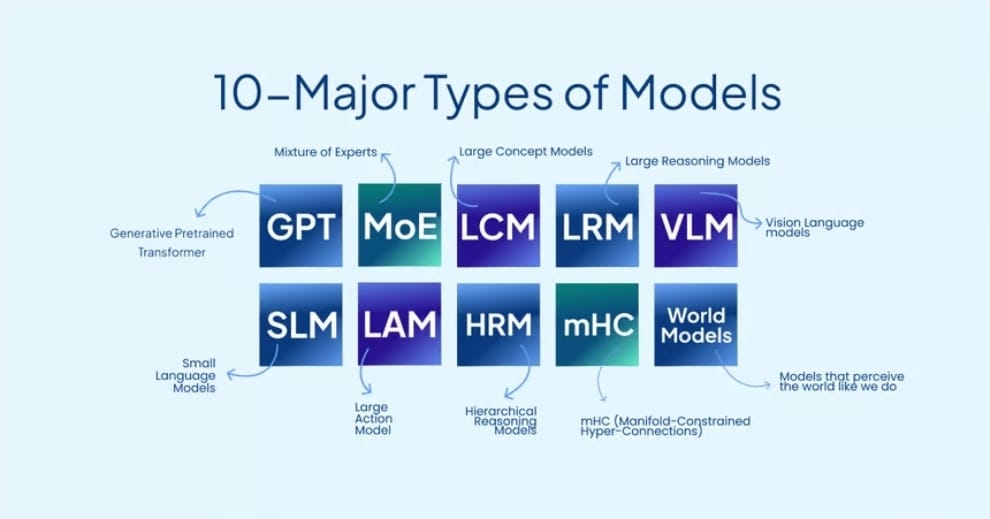
Here is the breakdown of the 10 model types and their specific roles in the Agentic Stack
Model Types for Enterprises
1. The Generalists (Foundational Intelligence)
GPT (Generative Pre-trained Transformer)
- What it is: The classic dense model architecture. It reads text/code and predicts the next token based on massive training data.
- Enterprise Role: The Orchestrator / The Face.
MoE (Mixture of Experts)
- What it is: A sparse architecture (like Mixtral or GPT-4 under the hood). Instead of activating the whole brain for every query, it activates only the relevant “experts” (e.g., the coding expert, the math expert).
- Enterprise Role: Cost-Efficient Scale.
2. The Thinkers (Reasoning amp; Logic)
LRM (Large Reasoning Models)
- What it is: “System 2” thinkers (e.g., OpenAI o1/o3, DeepSeek R1). These models are trained to “think before they speak,” generating hidden chains of thought to solve complex logic puzzles.
- Enterprise Role: The Architect / The Planner.
HRM (Hierarchical Reasoning Models)
- What it is: Models designed to break down problems into tree structures. They understand that Task A has Sub-task B and C, and C depends on D.
- Enterprise Role: Project Management.
LCM (Large Concept Models)
- What it is: Models optimized for abstract conceptualization and high-level semantic clustering, rather than granular token prediction. They excel at “getting the gist” or creative abstraction.
- Enterprise Role: The Creative Director.
3. The Doers (Action amp; Perception)
LAM (Large Action Models)
- What it is: The critical unlock for 2025/2026. These models are not trained just to write text; they are trained to understand UI, APIs, and Tools. They can output JSON to trigger a function or navigate a website.
- Enterprise Role: The Hands.
VLM (Vision Language Models)
- What it is: Multimodal models that can “see” images and video as natively as they read text (e.g., GPT-4V, Gemini Pro Vision).
- Enterprise Role: The Eyes.
World Models
- What it is: Models that simulate physical environments or systems. They predict “what happens next” in a video or a dynamic system (like Sora or Genie).
- Enterprise Role: The Simulator.
4. The Specialists (Efficiency amp; Structure)
SLM (Small Language Models)
- What it is: Tiny, efficient models (2B-8B parameters) that can run on a laptop or edge device (e.g., Phi, Llama Edge).
- Enterprise Role: Privacy & Speed.
mHC (Manifold-Constrained Hyper-Connections)
- What it is: Note: In an enterprise context, this refers to Graph-Neural Networks (GNNs) or models that understand complex, non-linear relationships (Knowledge Graphs). They map data points on a “manifold” rather than a linear sequence.
- Enterprise Role: The Connector / Fraud Detective.

🏗️ The Strategic Blueprint: Building the Composite Agent
If you are a strategist, your job is not to pick one model. It is to assemble a Cognitive Supply Chain.
Here is how you build an Enterprise Autonomous Invoice Auditor using this stack:
- The Eyes (VLM): Scans the PDF invoice and extracts line items.
- The Brain (LRM): Reasons through the complex tax code to determine if the “Meals & Entertainment” expense is compliant with 2026 regulations.
- The Memory (mHC): Checks the vendor against the internal Knowledge Graph to ensure they aren’t a shell company connected to an employee.
- The Hands (LAM): Logs into the ERP system (SAP/Oracle) via API to approve the payment or flag it for review.
- The Orchestrator (SLM): Runs locally on the server to sanitize PII before sending any data to the cloud models.
Summary Table for Decision Makers
Model Type Best For…Do NOT Use For…GPT General Chat, Summarization Math, Complex Logic, Privacy-Sensitive Data MoE High-volume tasks, Cost savings Deep reasoning, Niche scientific tasks LRM Coding, Legal, Complex Planning Real-time chat (too slow/expensive) LAM Executing API calls, Software navCreative writing, Open-ended chat SLM Edge devices, PII Privacy, Speed Complex reasoning, Broad world knowledge VLM Image/Video analysis Pure text tasks (inefficient)
The Bottom Line: The future of Enterprise AI isn’t about having the smartest model; it’s about having the right Team of Models.