
Think about the last time you moved. The excitement of a new job usually lasts about five minutes before the reality of the logistics sets in.
Suddenly, you’re staring down a mountain of friction: finding a home that doesn’t ruin your commute, hunting for trustworthy doctors, scouting schools, and figuring out if the dog will actually have a yard. It’s not just a move; it’s a full-time job you didn’t ask for.
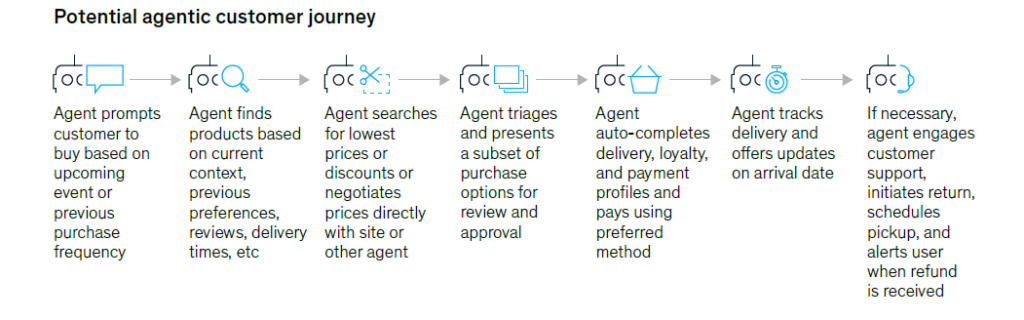
Now, imagine an autonomous AI agent stepping in to take the wheel. This isn’t just a search engine; it’s a strategist that understands your budget, your kids’ hobbies, and your lifestyle.
Here is how the “Agentic Era” transforms the moving experience
1. From Searching to Selecting
Instead of you scrolling through endless real estate listings, the agent sifts through the noise. It synthesizes data from dozens of platforms to find the few homes that actually fit your criteria. When you’re ready to sign, it reviews the lease, highlighting any atypical clauses that require a human eye.
2. The “Sell vs. Ship” Calculator
We’ve all asked the question: Is it worth $700 to ship this dresser, or should I just sell it for $200 and buy a new one?
The agent does the math for you. You snap a photo; it assesses the resale value, lists the item across marketplaces, and negotiates with buyers. For the items you replace, it sources local options that fit your style and even simulates how they’ll look in your new floor plan.
3. Logistics on Autopilot
The most stressful part of moving is the “hand-off.” The agent manages the entire chain, coordinating with movers, sourcing essentials from local retailers, and syncing every delivery so your bed arrives at the same time you do.
What is Agentic Commerce?
At its core, agentic commerce is the shift from “search-and-buy” to “delegate-and-verify.”
It’s shopping powered by intelligent AI agents that don’t just wait for your instructions. They anticipate them. Instead of you navigating a maze of filters and tabs, these agents use a deep understanding of your preferences to automate the friction out of the process. They don’t just find the product; they negotiate the price, verify the shipping logistics, and ensure the purchase aligns with your lifestyle.
This isn’t just a “better” version of e-commerce. We are witnessing a fundamental re-engineering of the digital marketplace. We’re moving away from a world where the consumer does the heavy lifting and into one where AI serves as a proactive personal shopper.
The shift in consumer behavior is already visible. According to recent McKinsey research, 44% of users who have tried AI-powered search now call it their “primary and preferred” method for finding information, comfortably outpacing the 31% who still cling to traditional search engines.
In short: Agentic commerce isn’t just a new way to shop. It’s the end of the “search bar” era and the beginning of the “intent” era.
AI agents promise to transform the consumer experience.
We are moving beyond the “human-readable” web.
Very soon, AI agents won’t just be a convenience; they will be the primary interface between your brand and your customer. We are looking at a transformation as seismic as the e-commerce revolution of the late 90s, but this time, it’s going to move much, much faster.
To understand the scale, look at the math. In 1999, when e-commerce was first finding its footing, there were roughly 100 million people online, less than 2% of the global population. Today, we have 5.6 billion people connected. That’s 68% of the world already plugged into the infrastructure needed for this shift.
Because we are so hyper-connected, the adoption curve won’t be a gradual climb; it will be a vertical spike.
The early days of the internet are littered with the names of companies that thought they could “wait and see” how e-commerce shook out. They didn’t just lose market share; they vanished. We are at that same crossroads today. Adapting to an agentic reality isn’t about making small tweaks to your website. It’s about rethinking your entire business model before the market moves on without you.
The risk of lagging behind isn’t just a competitive disadvantage anymore; it’s an existential threat.
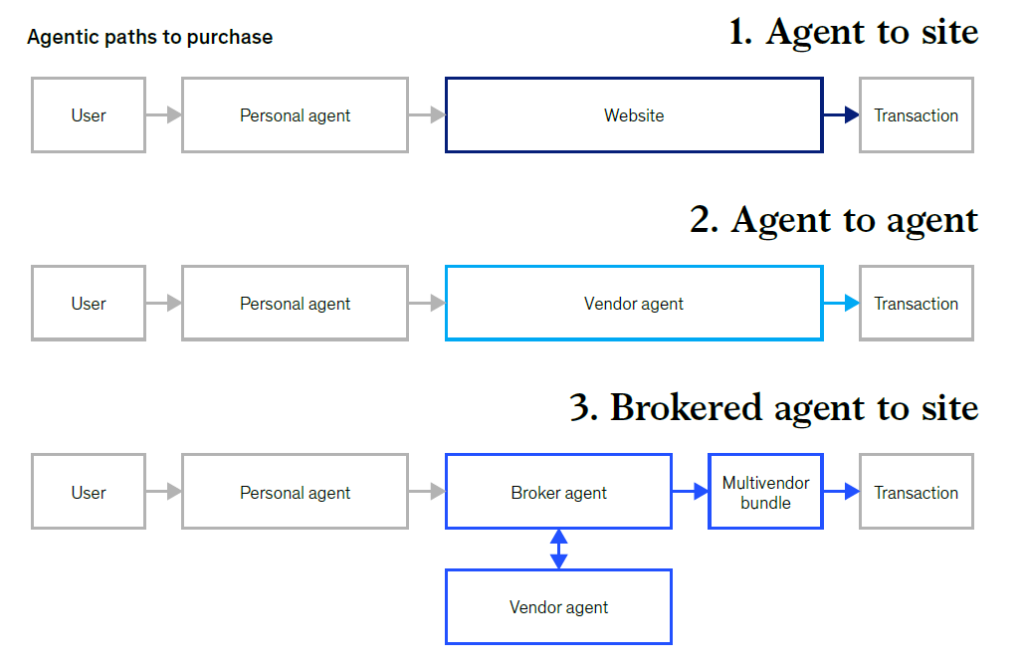
1. Agent to Site: The Digital Proxy
In this model, the agent acts as your sophisticated proxy. It navigates the “human-readable” web just like you would, but at machine speed.
How it looks: Instead of you spending an hour clicking through hotel filters, your travel agent scans dozens of merchant sites simultaneously. It ignores the fluff, highlights the three rooms that actually match your preference for “natural light and a quiet floor,” and waits for your final “yes” before executing the booking.
2. Agent to Agent: The Autonomous Negotiation
This is where the real magic happens: machines talking to machines. Your personal agent connects directly with a retailer’s internal commerce engine to handle the logistics and negotiations that humans usually find too tedious to bother with.
How it looks: You want to refresh your home office. Your personal shopping agent pings the retailer’s AI to negotiate a bundle discount across furniture, lighting, and tech departments, securing a price point that isn’t listed on the public site, all while you’re busy doing something else.
3. Brokered Agent to Site: The Ecosystem Orchestrator
In this scenario, a third-party “broker” acts as the connective tissue between your agent and a massive web of service providers. It’s an ecosystem play that simplifies complex multi-platform interactions.
How it looks: You tell your assistant you need a dinner reservation for four. Your agent doesn’t just search the web; it contacts a broker agent (like a next-gen OpenTable). The broker identifies the best table, cross-references your dietary restrictions, applies your loyalty discounts, and confirms the reservation, all through a single, seamless handshake.
Three possible paths to purchase in an agentic worls.
The structure of commerce is breaking wide open. We are moving away from manual search and endless comparison, replacing it with a machine-mediated reality where AI agents don’t just augment human decisions. They execute them.
While the exact pace of this shift was once a subject of debate, the technology is moving faster than anyone predicted. Unlike previous platform transitions, integrating agentic AI is relatively inexpensive and highly accessible. Because of this low barrier to entry, the economic gravity is massive.
According to recent 2026 McKinsey research, by 2030, the US B2C retail market alone could see $1 trillion in revenue orchestrated by agents. Globally, that opportunity stretches from $3 trillion to $5 trillion. And those figures only cover physical goods. They don’t even touch the massive B2B sector or the services economy.
The End of the “Destination” Site
For the last two decades, commerce has lived in vertical destinations. If you wanted to shop, you went to Amazon. If you wanted to book a flight, you went to Expedia.
Agentic commerce “de-verticalizes” that experience.
The future isn’t about navigating to a specific platform; it’s about an integrated, horizontal ecosystem. Think of it as a digital concierge that follows you across the web. Instead of opening five different apps to plan a business trip, you’ll voice your intent inside a tool you’re already using, like Slack, and the agent handles the rest. It collapses the funnel, making the “where” of the purchase irrelevant compared to the “what.”
From Prototype to Prime Time
This isn’t a “someday” scenario. The broad outline of this world is already here, with over half of all consumers now using AI for internet search. What begins as discovery is quickly carrying through to execution.
Look at the infrastructure that has rapidly rolled out across the tech sector:
Perplexity set the stage in late 2024 with “Buy with Pro,” bringing one-click, AI-assisted checkout directly into the search interface.
OpenAI followed up in early 2025 with Operator, an agentic system that gives ChatGPT the ability to autonomously browse the web, book travel, and make reservations.
By late 2025, OpenAI and Stripe (joined by Meta) introduced the Agentic Commerce Protocol (ACP). This open standard allows users to securely complete transactions using shared payment tokens inside an AI chat, meaning the customer never actually has to visit the merchant’s website.
Shopify is deeply integrating these protocols so agents can seamlessly crawl its catalogs and build carts, while giants like Google, Amazon, and Mastercard race to deploy their own agentic layers.
Collectively, these moves have turned agentic commerce from a futuristic concept into our current reality.
The New Retail Reality: 3 Questions for Leaders
For retailers, this shift is existential. You are no longer just competing for a human’s attention; you are competing for an agent’s recommendation. This is the time to ask the hard questions:
Where do you fit in? What new opportunities will agentic commerce create for your brand, and which legacy channels will it diminish?
How do you build loyalty with a machine? When your primary shopper is an agent, how do you maintain a strong, emotional bond with the human behind it?
How do you win the gatekeeper? In a world where AI agents are the new gatekeepers of consumer intent, what is your strategy to become indispensable to the algorithm?
This report will help leaders navigate these exact questions. The hypothetical cross-country move we described earlier illustrates what the agentic era feels like for consumers. Next, we will break down what it means for your business model, your tech stack, and the very nature of your customer relationships.
Creating the infrastructure for agentic commerce
Behind the scenes, developers are aggressively wiring together the infrastructure for this new era of commerce. But the real story here isn’t just about AI getting smarter; it’s about AI getting patient.
According to the research group METR, the length of time an AI can reliably work on a task has been doubling every seven months since 2019. Back then, leading models could only manage tasks that required a few seconds of human effort. By 2025, Anthropic’s Claude 3.7 Sonnet could stay focused on a task for roughly an hour. Today, with models like Claude 4.5, that “time horizon” has stretched past 30 human hours.
We have officially crossed an inflection point. AI is no longer limited to quick, transactional prompts; it can now manage multi-day, complex workflows.
This leap from quick answers to autonomous execution is being driven by a few critical pieces of infrastructure. Here are the three core protocols making the agentic economy possible:
1. Model Context Protocol (MCP): The Shared Memory
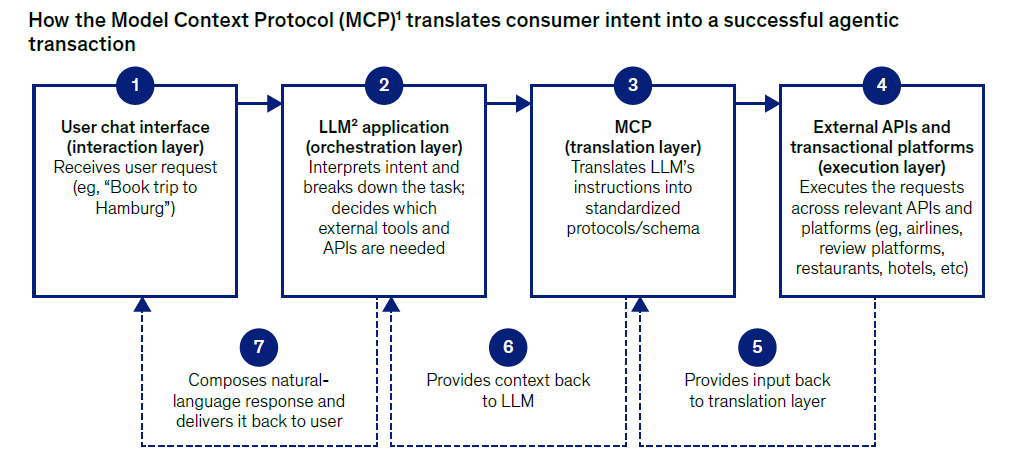
Think of MCP as the connective tissue between different platforms. Before this, asking an AI to do something across different apps was like talking to someone who resets their memory every five minutes. MCP changes that. It provides a standard way for agents to carry your context, intent, and past actions from one environment to the next. It’s what allows an agent to actually remember what you want as it moves seamlessly from your email, to a merchant’s catalog, to your calendar.
2. Agent-to-Agent Protocol (A2A): The Digital Handshake
This is where we remove the human bottleneck entirely. A2A is the standardized language that allows different AI agents, regardless of who built them or what platform they live on, to talk, negotiate, and collaborate. Imagine your personal shopping agent haggling directly with a retailer’s inventory agent to secure a bundle discount. A2A provides the secure framework for these machines to share data and execute long-running tasks autonomously, turning isolated AI tools into a collaborative, multi-agent workforce.
3. Agent Payments Protocol (AP2): The Autonomous Wallet
Having an AI shop for you is useless if it can’t safely complete the transaction. Google’s AP2 solves the final mile of agentic commerce: the payment. It allows an AI to make purchases on your behalf using cryptographically secured tokens that link your original “intent” to the final cart. Because the transaction is mathematically tied to your authorization, it creates a rock-solid audit trail. For consumers, it means safe, frictionless buying. For merchants, it means a massive reduction in fraud and chargebacks.
Ultimately, these protocols are doing something profound. They are taking the messy, fragmented reality of the internet and translating it into a unified language that machines can navigate on our behalf.
The Model Context Protocol standardizes how large language models connect to tools and take action across platforms.
Beyond the underlying protocols, developers are also deploying a new class of capabilities that allow AI to navigate the messy, unpredictable realities of human systems.
Here are the three advancements bridging the gap between digital theory and real-world execution:
Computer Use Agents: The “API Bypass”
Ideally, AI agents communicate cleanly through APIs. But what happens when a merchant’s website is outdated, or a niche service doesn’t have the budget for back-end integrations?
Older automation tools would simply break. Today’s “Computer Use” agents just use the front door. These systems are trained to visually process a screen, move a cursor, click buttons, and fill out forms exactly like a human would. If a system isn’t machine-readable, the AI essentially takes over the keyboard. It is the ultimate workaround, ensuring that agents aren’t locked out of the legacy web.
Contextual Personalization: The End of “Static” Shopping
We all know the frustration of the current recommendation model: you buy a vacuum once, and algorithms chase you with vacuum ads for six months.
Contextual AI fixes this by shifting from static, search-based guessing to dynamic, memory-driven understanding. These new architectures don’t just track your clicks; they retain long-term memory and infer your intent based on nuance. If you tell your agent you are planning a beach trip but suddenly start searching for cold-weather gear, the system instantly adapts to the context shift, recommending layered clothing without needing you to explicitly update your preferences.
Dynamic Planning: The “Living” Itinerary
Standard automation is incredibly fragile. If you use a traditional tool to book a trip and your first flight is delayed, the rest of the dominoes fall, leaving you to clean up the mess.
Dynamic planning agents don’t just execute a task; they actively monitor the variables. If your flight is delayed, the agent automatically kicks into gear. It rebooks your connection, messages the hotel about your late arrival, pushes back your dinner reservation, and updates your company expense report, all before you’ve even stepped off the runway. It treats complex, multi-step plans not as final outputs, but as living documents that require real-time adjustment.
What does the agentic ecosystem look like?
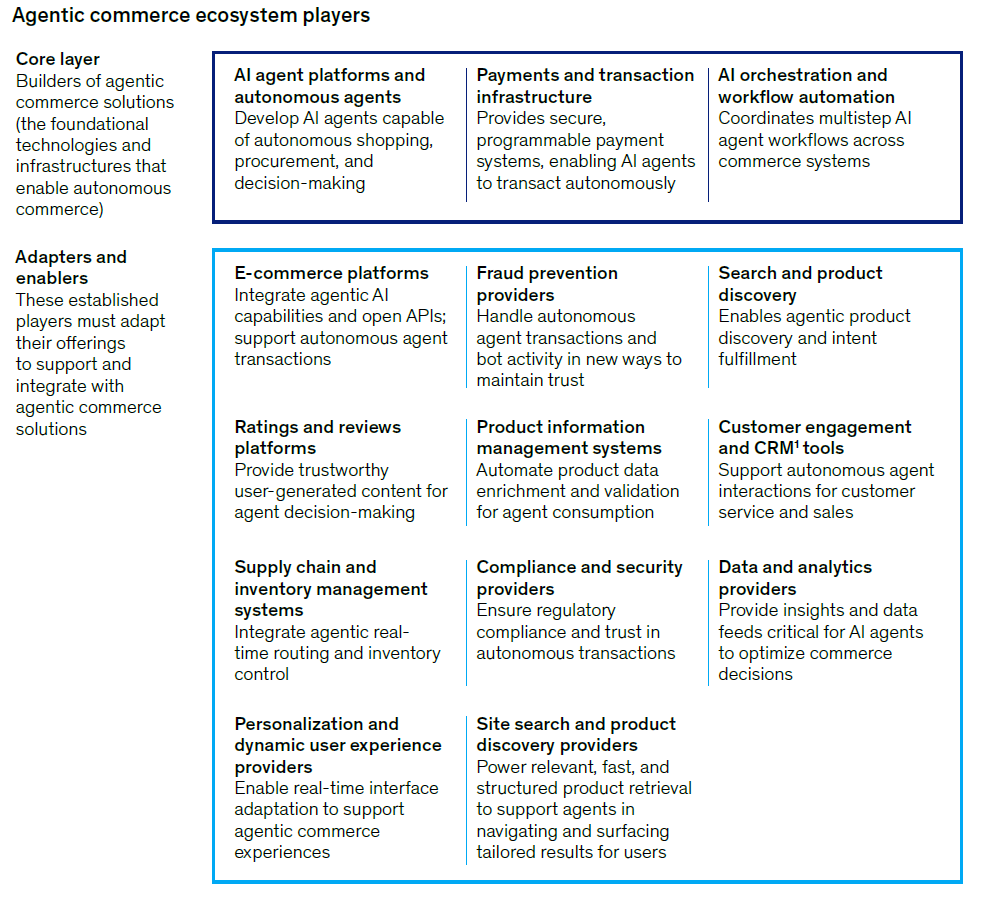
Much like the original e-commerce boom relied on a massive, hidden ecosystem of payment gateways, search engines, and logistics providers, the agentic era requires its own interconnected village to function. While the spotlight naturally falls on flashy AI models and autonomous agents, the true heavy lifting belongs to the “enablers”, the legacy storefronts, fraud prevention systems, and payment rails that must rapidly rewire themselves to serve machine buyers instead of human ones. Ultimately, the speed at which this new economy scales won’t just depend on how smart our AI becomes, but on how quickly the rest of the digital world can upgrade its infrastructure to let these autonomous shoppers through the front door.
Within the emerging agentic commerce ecosystem, adapters and enablers will determine the pace at which core players redefine commerce.
The Trillion-Dollar Question: How Do Agents Actually Pay?
Let’s address the elephant in the room: having an AI shop for you is great, but how do we safely hand a machine our wallet?
For decades, the entire global payment infrastructure, every gateway, risk engine, and fraud check, has been built around a human. Fraud prevention relies heavily on behavioral clues: how fast you type, where your mouse hovers, and the explicit click of a “Buy Now” button.
When the customer is an algorithm, that entire paradigm breaks.
We can no longer rely on human behaviors to verify intent. Instead, the payment industry has to shift from KYC (Know Your Customer) to KYA: Know Your Agent. The financial system must build protocol-level trust, requiring mathematical proof that an agent has the explicit, delegated authority to spend your money within specific parameters.
This isn’t a future problem; the financial sector is rewiring itself right now through two parallel tracks of rapid innovation:
1. Tech Giants Build New Standards
The major tech players are establishing entirely new frameworks for machine-to-machine trust. In late 2025, Google launched AP2, an open payment protocol that quickly secured backing from heavyweights like Mastercard, PayPal, and Alibaba. Instead of passing around credit card numbers, AP2 uses cryptographically signed mandates. It creates a rock-solid, mathematically auditable trail linking your original intent to the agent’s final purchase.
2. Legacy Networks Get an AI Upgrade
Simultaneously, the traditional financial rails are injecting programmability into their legacy systems to avoid being cut out of the loop.
Visa is aggressively positioning its global network as the backbone for agentic commerce. Teaming up with AI platforms like Anthropic, OpenAI, and Stripe, Visa is actively piloting transactions where agents spend on a user’s behalf, locked tightly within preset budgets. They’ve even introduced “AI-ready cards,” replacing static card details with tokenized credentials so merchants can instantly verify an agent’s authority.
Mastercard is pushing forward with its own “Agent Pay” solution, while industry consortiums work to extend verifiable web credentials directly into the checkout process.
3. The Silicon Valley Insurgents
Beyond the legacy players, a new wave of startups is building infrastructure natively for the agentic web. A prime example is Skyfire, which recently rolled out Agent Checkout powered by “KYAPay.” This open standard essentially acts like a corporate card for your AI. It assigns the agent a verified identity, applies strict spend controls, and tracks the agent’s reputation over time.
To survive the shift to agentic commerce, your tech stack needs to be fluent in machine-to-machine communication. The days of building APIs solely to connect your internal apps are over. In an AI-first economy, your API is your storefront. If an autonomous agent can’t easily “read” your catalog, verify pricing, and execute a task, your business effectively doesn’t exist in their world.
To ensure your brand isn’t left behind as these new interfaces take over, you need to rethink your technical strategy across three fronts:
Agentic System Designs Update
1. Build a Native AI Foundation
You cannot fast-follow your way into the agentic era. Future-proofing your brand means moving beyond superficial AI integrations and embedding these capabilities into your core operations today. The goal isn’t just to add a chatbot to your website; it is to build a technological foundation that anticipates an AI-driven marketplace, positioning your brand to lead rather than react as the tech matures.
2. Design for Modularity, Not Monopolies
It is incredibly tempting to sign an exclusive integration deal with one of the massive AI platforms and call your strategy complete. Don’t fall into the vendor lock-in trap. The AI landscape is incredibly volatile. With nimble insurgents like DeepSeek and Manus AI constantly pushing the boundaries and altering market dynamics, you need a flexible, modular architecture. Build an API infrastructure that allows you to easily swap out models and partners as the technology evolves, ensuring you remain in control of your own digital destiny.
3. Embed in the Builder Ecosystem
You cannot navigate this shift by reading industry reports from the sidelines. You need to forge direct, active relationships with the developers, startups, and incubators actually writing the code. Whether it’s in Silicon Valley or other rapidly emerging global tech hubs, establish a physical or highly active presence within these communities. The closer your teams are to the edge of AI innovation, the faster you can adapt when the ground inevitably shifts again.
Business model evolution in the era of agentic commerce
In 1942, economist Joseph Schumpeter coined the term “creative destruction” to describe how new technologies obliterate old economic structures to make way for the new. If you want to see what creative destruction looks like in real time, look at agentic commerce.
Surviving this paradigm shift requires a lot more than a UI refresh or slapping a new coat of paint on your mobile app. It requires grappling with a jarring new reality: your target audience is no longer a human with a browser. Your buyer is an autonomous algorithm.
Because of that, every assumption we have about how products are discovered, how pricing decisions are made, and how brand loyalty is forged is being rewritten.
We are already past the theoretical phase. With ChatGPT now commanding over 800 million weekly users and Google’s AI Overviews reaching 1.5 billion people a month, the behavioral shift is baked in. Commerce is actively rerouting through AI channels. In our hyper-connected economy, adoption doesn’t climb a gentle slope; it spikes. As consumers realize they can simply delegate their mental load to an agent, their buying habits will permanently change.
History shows us that every major technological wave aggressively redistributes market value. The shift to an AI-first web will be no exception.
So, how do you respond?
The bare minimum: You must optimize your product directories and APIs for machine readability. If an agent can’t effortlessly parse your inventory, you simply don’t exist in their world.
The middle ground: You begin piloting agent-first experiences, removing the friction from your traditional sales funnels.
The ultimate goal: You reimagine your business model entirely. You stop fighting to be a destination site and instead become an indispensable layer in the new, agent-driven ecosystem.
You can adapt to the new rules of the marketplace, or you can be creatively destroyed. But one thing is absolutely certain: remaining static is no longer a viable option.