

Agentic AI is artificial intelligence that can pursue a defined goal on its own, by planning the steps, using tools and systems, and adjusting course as conditions change.
Agentic AI moves beyond answering prompts or generating content to execute work. In enterprises, agentic AI will increase productivity, as people become AI supervisors rather than task executors. It will shift roles and redefine decision making by democratizing technical skills, increasing employee autonomy, and accelerating decision cycles. Agentic AI will require leaders to marry business and technology expertise, treating it not as a technology rollout but as a business transformation enabled by AI.
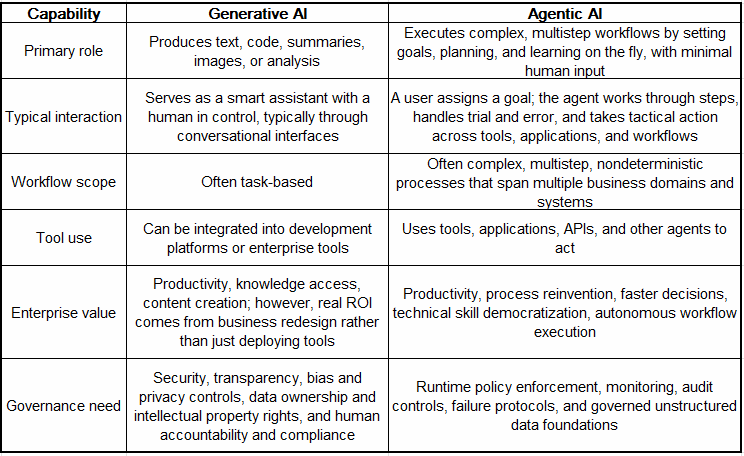
Agentic AI vs. generative AI
Generative AI gave us copilots that assist human work by generating output. Agentic AI can reason, collaborate, and coordinate multistep work across systems.
How does agentic AI work in enterprises?
In enterprises, agentic AI entails deploying autonomous agents that can reason, dynamically coordinate with other agents and systems, and execute complex, non-linear workflows. Agentic AI moves work beyond single-task automation into end-to-end process execution, shifting from “predictive” interactions to “goal-oriented” autonomy.
That raises complexity well beyond what existing enterprise platforms were designed to handle. Modern agentic systems are increasingly autonomous, nondeterministic, and multi-agent. Agents operate in collaborative swarms rather than isolation. Operationally, each agent may leverage advanced reasoning models to plan sub-tasks, invoke APIs, execute code in sandboxed environments, query multimodal knowledge bases using hybrid search (vector and graph), and pass rich, evolving context to downstream agents within a single request.
Few companies are ready. Capturing the full value of agentic AI will require rethinking systems, data, and governance. For scalable, safe, and resilient agent deployment, leaders must integrate AI TRiSM (AI Trust, Risk, and Security Management) from the start, rather than bolting on security later. Agentic AI calls for a unified governance fabric that manages agent identity, runtime guardrails like real-time prompt-injection filtering and semantic safety controls, and immutable end-to-end traceability.
To meet the new requirements of agentic AI, organizations are modernizing their platforms around a three-layer architecture:
Orchestration. The application and orchestration layer is the command center. It leverages agentic frameworks to manage dynamic, multistep workflows, handle recursive tool calls, manage context handoffs between specialized agents, and enforce execution controls across the agent swarm.
Observability. The analytics and insight layer provides real-time visibility into agentic intent, not just system health. It captures metrics, logs, and traces across reasoning paths, allowing for full “thought-process” transparency, enabling human auditors to understand why an agent made a specific decision.
Governed data access. This is the data foundation for agentic systems. It provides agents with consistent, governed access to structured, unstructured, and real-time streaming data across domains, ensuring data lineage and privacy compliance through standardized, secure interfaces.
Finally, agentic AI is a business transformation, not just a technology rollout. Leaders will be strategic about where to deploy autonomous agents, clear on defining “human-in-the-loop” thresholds for high-stakes decisions, and bold in placing bets that move the organization beyond incremental productivity gains toward autonomous enterprise operations.
What are the levels of agentic AI maturity?
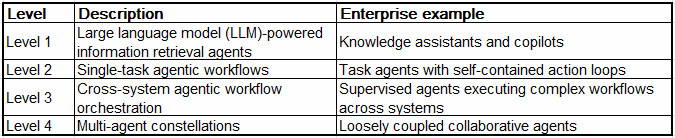
Tech-forward companies scaled Level 1 in 2023 and 2024, with varying degrees of success. When deployed in a diffuse way, these so-called agents delivered microproductivity. Real gains required deep embedding in functional workflows with heavy data cleaning and curation as well as continuous high-quality governance.
Levels 2 and 3 are where capital, innovation, and deployment velocity are converging. Level 4 remains earlier-stage, limited by practical barriers including:
- organizational silos;
- a lack of communication standards;
- compounding errors in multistep tasks;
- data readiness;
- concerns around privacy, security, and intellectual property;
- and vendor-fueled standards battles and walled gardens.
What makes agentic AI different from earlier AI?
Agentic AI differs from earlier AI in five ways:
It is goal-oriented and reasoning-driven. Beyond simple action-taking, agentic AI uses advanced reasoning models to decompose high-level objectives into actionable plans. Traditional analytics could only describe past states, and early AI was limited to static task execution; agentic systems dynamically adapt to evolving context and resolve ambiguities as work unfolds.
It is workflow-aware and multi-agent. Early AI was contained, deterministic, and siloed. We are shifting to connected, nondeterministic, “swarm” architectures where multiple specialized agents collaborate. These systems support complex, non-linear orchestration workflows where agents negotiate tasks and handle exceptions autonomously.
It depends on dynamic tool environments. Agents now discover and utilize tools in real-time via standards like the Model Context Protocol (MCP) and dynamic tool catalogs. They can invoke APIs, execute code in isolated environments, and perform hybrid searches across knowledge bases. This requires a robust security posture, implementing contextual, least-privilege permissions for every tool invocation.
It requires a dedicated orchestration and memory layer. To manage agentic complexity, enterprises must implement a specialized layer that orchestrates control flow, manages long-term memory (state persistence), handles recursive retries, and coordinates parallel execution and context handoffs across heterogeneous agent teams.
It raises the governance and “trust” bar. With agentic AI, governance must expand beyond static model outputs to encompass agentic behaviors and decisions. This necessitates a centralized governance fabric that enforces runtime guardrails, such as semantic safety filters and goal-alignment checks, while providing full traceability of the reasoning path for auditability.
Where is agentic AI used in enterprises?
Enterprises can use agentic AI wherever work is multistep and requires reasoning, long-term memory, and coordination across systems. We are moving beyond the pilot phase into an era of autonomous operations, where agentic systems deliver compounding value across industries.
Customer experience
Agentic AI is transforming customer experiences by unifying the front stage (customer-facing) and the backstage (operational machinery). The most successful companies are moving beyond simple chatbots to “autonomous agents” that can navigate complex internal systems to resolve issues without human intervention. By synchronizing the front-stage experience with the backend, they are autonomously routing requests, executing multi-step remediations, and predicting service needs, creating a seamless, “zero-friction” journey.
Retail and commerce
In retail, agentic AI is redefining the path to purchase. AI agents act as personal shoppers, conducting discovery, research, and comparative analysis, often bypassing traditional web interfaces entirely. We are entering the age of agentic commerce, where the transaction happens between a consumer’s agent and a retailer’s agent. Retailers must now optimize for “agent-to-agent” discovery while maintaining brand control. Winning companies will prioritize visibility in agent search results, secure their data foundations, and ensure their fulfillment engines can interface directly with external buying agents.
Marketing
Marketing is shifting toward a model where AI agents act as the primary intermediaries between brands and buyers. As “zero-click” and agentic search compress the discovery-to-decision journey, the traditional marketing funnel is eroding. Leading marketers are pivoting to Agent-Ready Optimization (ARO), structuring content, brand data, and performance metrics to ensure that the AI agent (as the primary audience) can accurately represent the brand’s value proposition to the human buyer.
Sales
In sales, agentic AI is evolving from simple task automation to autonomous SDR and GTM operations. High-value use cases now include:
Autonomous prospecting: Sourcing and qualifying leads across disparate data silos.
Dynamic guided selling: Agents co-piloting deals with real-time research and objection handling.
Automated revenue operations: Managing complex forecasting, contract lifecycle, and cross-functional administrative artifacts.
To succeed, sales organizations must transition from fragmented tooling to unified, agentic-ready platforms that treat data as a strategic asset rather than a byproduct.
Banking and financial services
In financial services, agentic AI is reducing friction in core operations like compliance, personalized financial planning, and cross-departmental settlements. By leveraging modular architectures and industry-standard frameworks, banks are building “agent-friendly” data foundations. These systems allow agents to securely access sensitive, governed data to execute complex financial transactions, providing real-time, personalized guidance while maintaining rigorous regulatory compliance.
Insurance
Insurance is a prime candidate for end-to-end autonomous journeys. In auto or property claims, agentic systems are connecting the entire value chain, from instant damage assessment and fraud detection to settlement and contractor fulfillment. By replacing manual, siloed steps with a continuous agentic workflow, insurers can drastically reduce cycle times, lower loss adjustment expenses, and shift the focus toward proactive risk prevention.
ERP and enterprise operations
In ERP, agentic AI is transforming static interfaces into autonomous execution engines. Rather than employees navigating complex software, they act as “supervisors” of agent swarms that manage “touchless” core processes, from procure-to-pay to financial close. Research indicates a significant shift is underway: most IT leaders expect substantial ERP functionality to be natively handled by agentic systems by 2028, effectively turning the ERP into an intelligent system that executes, rather than just records, business operations.
Overcoming the pilot trap
Despite the potential, many organizations remain stuck in pilot mode. Common roadblocks include:
Orchestration fragility: Lacking the infrastructure to manage agent-to-agent handoffs and memory.
Governance gaps: Unclear policies for autonomous decision-making and human-in-the-loop triggers.
Data Silos: Inability to provide agents with consistent, governed access to the data required for reasoning.
Organizational resistance: A lack of clarity on how roles and accountability structures must change.
Long-running enterprise work
We are witnessing a shift from episodic agents (which perform bounded, transient tasks) to long-running agents (which maintain long-term goals, state, and institutional context). Long-running agents are “developmental”. They accumulate domain knowledge, improve their judgment over time, and learn from past outcomes. In complex fields like legal, healthcare coordination, and corporate procurement, these agents don’t just reduce labor costs; they become institutional assets that retain and apply organizational intelligence, fundamentally outperforming human-only processes over time.
What business value can agentic AI create?
Agentic AI is reshaping enterprise value creation, moving beyond simple task automation to autonomous workflow orchestration.
It is unlocking significant new economic potential across industries. Gartner notes that agentic AI is disrupting traditional software models, with up to $234 billion in enterprise application software spending now exposed to “agentic arbitrage” as organizations shift from seat-based licenses to outcome-based value. Furthermore, specific sectors are seeing massive expansion; for instance, spending on agentic AI-capable supply chain management software is projected to grow from less than $2 billion in 2025 to $53 billion by 2030.
Beyond growth, agentic AI is fundamentally altering the cost structure of operations. By enabling systems to complete tasks across multiple interfaces without human intervention, it reduces reliance on manual effort and traditional UX-heavy applications. While experimentation is widespread, top-tier organizations are moving toward “agentic mesh” architectures, where agents collaborate to manage end-to-end workflows, which are proving essential to capturing material impact on the bottom line.
The greatest gains are shifting toward total workflow reinvention. McKinsey and BCG emphasize that while copilots deliver diffuse, incremental benefits, true value comes from “vertical,” function-specific use cases where workflows are redesigned with agents at the core. Organizations that successfully scale these agentic systems, supported by robust governance, data integration, and clear success metrics, are achieving substantial EBITDA gains and operational agility. However, the market is also marked by a “capability-deployment verification gap,” with analysts warning that over 40% of agentic projects risk cancellation by 2027 unless firms move beyond “agent washing” to prioritize operational discipline and defined business outcomes.
What architecture does agentic AI require?
Agentic AI requires a fundamental shift in enterprise architecture, moving away from monolithic request-response systems toward dynamic, event-driven, and multi-agent frameworks. Legacy stacks are inherently limited by rigid integration patterns, whereas agentic systems demand fluid, iterative interactions that span heterogeneous environments.
Scaling agentic AI hinges on an architectural evolution toward “agentic orchestration layers.” Agents require persistent memory, complex tool-use capabilities, and the ability to autonomously chain APIs, execute sandboxed code, and maintain cross-agent context. Without a dedicated infrastructure to manage this complexity, enterprises struggle to transition from isolated, brittle prototypes to resilient, production-grade applications.
Recent industry research emphasizes that architectural maturity is the primary differentiator for capturing enterprise value. Moving from experimentation to sustained impact requires moving toward an integrated “Agentic Fabric” that abstracts complexity and standardizes how agents discover, interact, and govern one another.
Transitioning to this connected, agent-centric architecture offers four critical strategic advantages:
Operational Efficiency through Abstraction: A unified orchestration layer abstracts the underlying complexity of tool calling and data retrieval, allowing developers to build new capabilities without re-engineering existing silos, significantly reducing the marginal cost of deployment.
Contextual Intelligence and Precision: By enabling shared, real-time memory and unified data access, agents can maintain situational awareness across multistep workflows, dramatically reducing hallucination rates and improving the accuracy of autonomous decisions.
Governance and Deterministic Control: Centralized observability platforms allow organizations to monitor nondeterministic agent behavior, enabling “human-in-the-loop” checkpoints and rigorous compliance monitoring that are impossible in fragmented, decentralized environments.
Modular Resilience at Scale: An architectural approach based on modular, swappable agent components ensures that systems remain reliable and maintainable, allowing companies to replace or upgrade specific capabilities without disrupting the entire end-to-end workflow.
What risks and challenges come with agentic AI?
Agentic AI brings several risks and challenges to companies, including:
- Legacy architecture. Agentic systems need shared context, orchestration, and runtime governance to support multi-turn, adaptive workflows. Legacy stacks were never built to provide these capabilities.
- Interoperability and integration. Consistent interoperability standards and frictionless integrations are critical to break down organizational silos and capture the full value of agentic AI.
- Data quality and access. Agents can’t act without governed access to structured and unstructured data.
- Governance and decision transparency. As agents take on more decision making, organizations need the ability to observe and explain agent behavior.
- Privacy, security, and intellectual property concerns. For agentic AI to scale safely across the enterprise, the guardrails to execute safely, securely, and cost-effectively must be built in from the start. This is essential to mitigate operational, customer, compliance, and reputational risk.
- Trust and judgment. Customers and employees need to feel confident as agents become more autonomous and cross-functional. It’s up to leaders to determine where to deploy agents and where to keep humans in the loop.
These challenges are not reasons to wait; they are reasons to design agentic AI strategically.
How will agentic AI change the workforce and operating model?
Agentic AI will transform the workforce and the operating model by shifting people from task executors to AI supervisors. Agents democratize technical skills, increasing the breadth of employee roles. They will redefine decision making, speeding up decision cycles and increasing employee autonomy. As agents expedite work, blurring boundaries between roles and organizing work around outcomes rather than functions, human collaboration is critical.
Agents increase the risk of unintended consequences, expanding the risk management role. Agentic AI makes judgment, not capacity, the scarce organizational resource. As agents shift the focus from who does work to who owns the work, org charts become “accountability charts.”
Long-running agents add another layer. Most agents today are episodic: They perform a bounded task, then lose context between sessions. Long-running agents maintain goals, preserve decisions, and accumulate knowledge across extended workflows. That could shift AI from a transactional productivity tool toward a more persistent operational capability.
But persistence raises new questions. Who owns the memory an agent accumulates? How should permissions change over time? How will companies keep memory clean, portable, secure, and governed? These questions will shape the next enterprise operating model.