


We are living through the “Tower of Babel” phase of Agentic AI.
Right now, if you ask an AI agent to “find me a blue medium shirt and buy it,” the agent has to struggle. It has to scrape HTML, guess which div contains the price, fight through a CAPTCHA, and hope it identified the right “Add to Cart” button.
The web was built for human eyes, not for AI logic. This friction is the single biggest bottleneck holding back the multi-trillion-dollar promise of Agentic Commerce.
Enter Google’s Universal Commerce Protocol (UCP).
Google is quietly rolling out an open-source standard designed to be the “Universal Translator” for the agentic age. UCP is not a product; it is a protocol. It transforms unstructured e-commerce chaos into a structured, semantic language that any AI agent, whether from Google, OpenAI, or a startup, can read, understand, and transact with.
For Commerce SaaS platforms (Shopify, BigCommerce, Salesforce, commercetools), this is not just a new feature. It is a fundamental rewriting of the competitive landscape.
Here is how UCP works, and why it will force every SaaS provider to re-architect their platform.
The Core Problem: The Translation Gap
Today, Commerce SaaS platforms compete on Visuals. They sell themes, drag-and-drop builders, and frontend experiences.
However, an AI Agent is blind to visuals. It cares about Semantics.
- Human: Sees a picture of a sneaker and a red “Sale” sticker.
- AI (without UCP): Sees <img src=”shoe.jpg”> and <span class=”red-text”>. It has to guess the context.
- AI (with UCP): Receives a structured JSON payload: {“product”: “Sneaker”, “condition”: “new”, “price_type”: “discounted”, “inventory_status”: “in_stock”}.
Google’s UCP essentially creates a standardized API layer for the entire internet. It decouples the Product Data from the Visual Presentation, allowing agents to interact with a store’s inventory and checkout logic directly, without ever rendering the website.
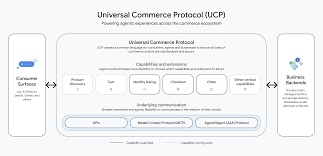
How UCP Transforms the Commerce SaaS Model
If UCP becomes the standard (and with Google backing it, it likely will), the value proposition of Commerce SaaS shifts dramatically.
1. From Headless to Agentic-First Architecture
We spent the last five years moving to “Headless Commerce” (separating the backend from the frontend). UCP pushes this to its logical extreme: “Interface-less Commerce.”
- The Shift: SaaS platforms must stop prioritizing HTML generation and start prioritizing Semantic Data Exposure.
- The Impact: A Commerce SaaS platform will be judged not by how beautiful its storefronts are, but by how “readable” its UCP endpoints are. If a SaaS platform fails to output UCP-compliant data, its merchants will be invisible to Google’s Gemini and other shopping agents.
2. The Democratization of Discovery (The End of SEO as We Know It)
Currently, big retailers with massive SEO budgets win on Google. UCP levels the playing field.
- The Shift: UCP relies on structured data, not backlink authority or keyword stuffing. A small merchant running on a UCP-compliant SaaS platform becomes just as “discoverable” to an AI agent as a massive retailer.
- The Impact: SaaS platforms will race to automate UCP compliance. The new “feature war” will be: “Our platform automatically tags your attributes better than theirs, so AI agents rank your products higher.”
3. The State Machine Requirement
Buying isn’t just about finding a product; it’s about the lifecycle (Order Placed -> Shipped -> Delivered -> Returned). Agents need to know the state of an order to be useful.
- The Shift: UCP standardizes how these states are communicated.
- The Impact: SaaS platforms must expose their internal order management logic via UCP. This means an AI agent can proactively ping the SaaS platform to ask, “Where is my order?” and get a structured response, eliminating millions of human support tickets. SaaS providers that integrate UCP deep into their OMS (Order Management System) will win.
The New Competitive Moat: Semantic Density
In the UCP era, the SaaS platform that provides the most detail wins.
Imagine a user asks an agent: “Find me a camping chair that supports 300lbs and is made of recycled materials.”
- SaaS Platform A: Exports standard UCP data (Name, Price, SKU). Result: Ignored by the Agent.
- SaaS Platform B: Exports “Semantic Density” (Weight Capacity, Material Composition, Sustainability Rating). Result: The Agent selects this product.
Commerce SaaS platforms will need to rebuild their PIM (Product Information Management) systems to force merchants to input this granular data, knowing it is the key to Agentic discovery.
The Verdict: Adapt or Become Invisible
Google UCP is the signal that the “Visual Web” is becoming the “Semantic Web.”
For Commerce SaaS leaders, the roadmap is clear:
- Native UCP Support: Bake the protocol into the core kernel. Don’t rely on plugins.
- AI-Ready PIM: Force structured data entry. Fluffy descriptions are dead; attributes are king.
- Agent Analytics: Build dashboards that tell merchants, “500 AI agents viewed your product today, and here is why they didn’t buy.”
The next battleground isn’t about capturing the human eye. It’s about speaking the machine’s language. And UCP just wrote the dictionary.