

Marketing has crossed a threshold. Your customers aren’t just navigating the web anymore; they are increasingly relying on AI to discover, evaluate, and purchase on their behalf.
To survive this shift, marketing can no longer be confined to traditional campaigns and isolated channels. It must become a real-time growth engine. In this new environment, the ultimate advantage belongs to brands that can design experiences not just for human consumers, but for the AI systems guiding them. Consequently, the CMO’s job description has fundamentally changed: you are no longer just a steward of brand and demand. You are an orchestrator of data, technology, and AI execution.
But let’s be honest about where we are today: executing this is incredibly hard.
Marketers were the first to jump on the generative AI bandwagon, using it to rapidly churn out copy and generate concept art. Yet, despite all this frantic activity, most departments have hit a wall. We’ve built a patchwork of isolated tools that help an individual work faster, but fail to move the enterprise needle.
Why? Because these tools are layered on top of legacy tech stacks, fragmented CRMs, clunky digital asset managers, and isolated analytics, that were never designed for shared data models. Welcome to the “Gen AI Paradox”: the technology is everywhere in your department, except on your bottom line.
Agentic AI is the way out of this trap.
Instead of treating AI as a fragmented tool to boost personal productivity, we are entering the era of the hybrid workforce. Agentic systems don’t just generate content; they execute complex, multi-step processes autonomously. In this new model, a single marketing professional doesn’t grind through the execution. Instead, they supervise a highly specialized team of digital agents. The machine handles the production, freeing the human to do what they actually get paid for: strategy, taste, and creativity.
But here is the hard truth: you cannot simply drop an AI agent into a legacy workflow and expect magic. If you try to automate a broken process, you will just get a highly efficient mess. To realize the promise of a hybrid workforce, you have to rebuild the foundation, creating unified data layers and exposing reliable APIs that agents can actually read and act upon.
We are still in the early days of this shift, but the blueprint for success is already emerging. If you are ready to stop buying isolated tools and start building an autonomous workforce, here is the five-step process for rebuilding your marketing engine for the agentic age.
The value of agentic AI in marketing
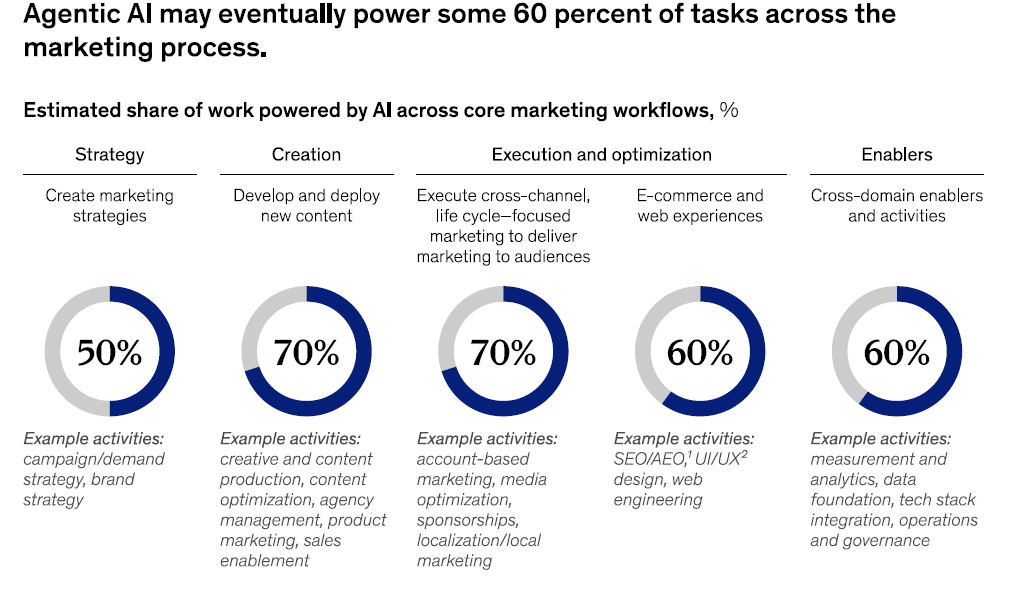
We estimate that agentic AI will come to power as much as two-thirds of current marketing activities, enabling tasks such as automated content generation, synthetic audience testing, and audience-based media planning
When you finally get this right, when you shift from treating AI as a scattered tool to orchestrating it as a digital workforce, the entire physics of your marketing operations changes.
We are seeing this transformation manifest in three distinct ways:
1. The “Always-On” Revenue Engine
According to our research, organizations transitioning to agentic workflows are unlocking 10% to 30% in net-new revenue. This isn’t coming from doing the same things slightly better. It’s driven by hyper-personalized, autonomous campaigns that never sleep. When agents bridge the gap between isolated channels, your marketing engine shifts from episodic, manual pushes to an always-on, self-serve revenue generator.
2. Velocity at Scale
The traditional campaign cycle is simply too slow for today’s market. Agentic systems are accelerating content creation and execution by 10x to 15x. Think about that math. By letting machines handle the grueling production cycles, data pulls, and initial vetting, human teams can test, iterate, and deploy at a speed that used to be physically impossible.
3. Flipping the Spending Ratio
Historically, a massive chunk of any marketing budget is lost to the “plumbing”, the manual operations, the process management, and the endless agency feedback loops. Agentic AI strips out that operational overhead. This allows you to reallocate those dollars directly into “working spend” that actually reaches the consumer. The machine handles the logistics; the human drives the strategy, resulting in a radically higher ROI on your media and creative performance.
But let’s be clear: none of this happens by default. You don’t unlock 10x velocity just by buying a new software license. You only capture this value if you are willing to tear down your traditional workflows and rebuild them around the machine.
Building an agentic marketing organization requires a five-steps process
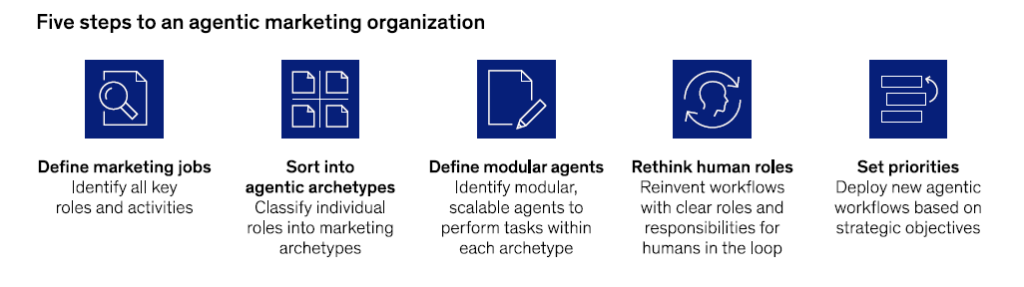
Step 1: Create a detailed taxonomy of key marketing activities
To build an autonomous workforce, you have to confront a harsh reality: you probably don’t know exactly how your team’s work gets done today.
You cannot automate a process you haven’t mapped. Before you write a single prompt or provision a new agent, you must break your priority workflows down to a microscopic level. And don’t just map the human steps. Map the plumbing. Document the exact CRM, CMS, and digital asset management tools involved, because the hard limits of your legacy systems will dictate exactly what your agents can and cannot do.
Here is how this looks in the real world.
Take a global consumer brand that wanted to fix its creative supply chain. Historically, launching a new campaign was a grueling, multi-month marathon of endless feedback loops between internal staff and outside agencies. To untangle this, they didn’t just write “Ideation and Production” on a whiteboard. They mapped the micro-friction.
They broke the workflow into hundreds of specific micro-tasks. Under “concept creation,” they identified the exact steps: generating the initial image, running the focus group pre-test, conducting the legal risk assessment, and versioning the assets for different channels. This wasn’t just a corporate mapping exercise. This highly granular taxonomy became the literal spec sheet they used to build their AI agents.
Crucially, you must also map the “thinking” work.
Your insights engine, the processes for synthesizing data, interpreting consumer signals, and generating hypotheses, needs to be documented just as rigorously as your production tasks. Agentic workflows can accelerate this intelligence gathering exponentially, crunching millions of data points in seconds. But by mapping it out, you clearly define the boundary where the machine stops and the marketer steps in to do what only a human can: look at the data and decide what it all actually means.
Step 2: Define Your "Agentic Archetypes"
Once you have a granular map of your workflow, you will likely be staring at a massive, overwhelming list of micro-tasks. The immediate instinct is to start building a bespoke AI tool to solve every individual chore.
Don’t. That is how you end up with an unmanageable, disconnected tech stack.
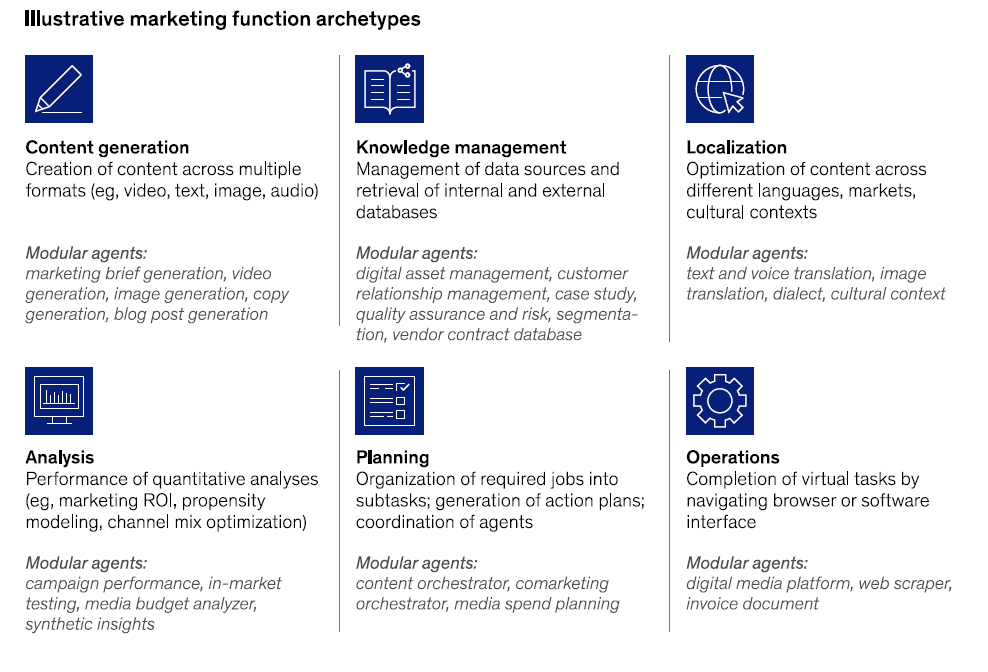
Instead, you need to look for the patterns. Step two is about clustering those hundreds of micro-tasks into reusable blueprints, or “Agentic Archetypes.” Think of these archetypes as the official job titles for your new digital workforce.
When the consumer brand we mentioned earlier looked at their sprawling taxonomy, they didn’t build a hundred different bots. They distilled the chaos down into six core archetypes:
The Content Generator: Responsible for drafting copy, generating images, and creating video variations.
The Knowledge Manager: Tasked with extracting internal context, brand guidelines, and historical data to keep the team aligned.
The Analyzer: Crunching campaign data and consumer signals to recommend the next best action.
The Localizer: Adapting core assets for specific dialects, cultural nuances, and regional regulations.
The Planner: Orchestrating timelines and coordinating hand-offs between different teams.
The Operator: Actually navigating the software, clicking buttons, filling out forms, and executing the final deployment.
By defining these archetypes upfront, you aren’t just solving a one-off problem for a single project. You are creating a modular, scalable roster of digital talent that can be mixed, matched, and deployed across any future campaign your department dreams up.
Step 3: Determine the full set of agents needed across workflows
Once you have your archetypes, your digital job titles, it is time to actually hire the talent. You need to define the specific agents required to bring those workflows to life.
But here is where most enterprise AI initiatives crash into reality: the bottleneck is rarely the AI model itself. It is system interoperability. If your shiny new agent cannot seamlessly plug into your CRM, read your content repositories, and execute directly within your activation platforms, it is nothing more than an expensive toy.
To do this right, you have to think in modules.
Look back at the consumer brand we’ve been tracking. Under their “Content Generator” archetype, they didn’t try to build one omnipotent, do-it-all bot. Instead, they built nearly 100 highly specialized, modular agents. Think of these as reusable digital Lego blocks. A specialized “short-form text agent,” for instance, isn’t locked into a single campaign. It can be dynamically inserted across the enterprise to draft social copy on Monday, optimize e-commerce listings on Tuesday, and generate B2B sales collateral on Wednesday.
The major marketing tech platforms are already recognizing this shift and building accordingly. Heavyweights like Adobe and HubSpot are now embedding agentic capabilities directly into their core infrastructure. These agents can autonomously spin up design variations, tailor copy to micro-segments, and adjust live content based on real-time behavioral signals.
This creates a powerful new dynamic. The human marketer acts as the strategic editor, guarding brand integrity and setting the vision, while the agents act as an infinite, tireless production studio. Early pilots are already proving the thesis: production cycles shrink from weeks to hours, finally giving brands the agility to respond to market shifts the moment they happen.
Step 4. Define future-state workflows with clear roles for humans in the loop
You cannot drop an autonomous workforce into your department and expect your human org chart to stay the same. The days of the marketer as a manual producer are ending.
When the machine handles the grueling execution, your people must pivot to the things an algorithm cannot replicate. The new mandate is focused on strategy, cultural “taste,” and profound empathy. Marketers must spend their time understanding exactly what resonates with a human audience, building actual relationships, and driving in-person brand activations.
But this doesn’t mean your team gets to ignore the technology. In fact, they must become its managers. Overseeing this new ecosystem requires a firm grip on the underlying infrastructure, understanding data schemas, content metadata, and the API governance that keeps your digital workforce operating safely.
This requires a massive upskilling effort. The modern marketer needs a radically updated skillset:
The Orchestrator: Mastering the complex handoffs between specialized agents and human teams, steering the machine toward the overarching strategy rather than just accepting its first output.
The Prompt Architect: Structuring instructions with engineering-level precision to guarantee the exact desired result.
The Quality Auditor: Monitoring autonomous activity for brand safety, legal compliance, and the subtle quality anomalies that a machine might miss.
The Taste-Maker: Taking the raw, high-volume output of an AI and elevating it with the instinct, nuance, and emotional resonance earned through years of real-world experience.
The Data Pragmatist: Knowing how to prep datasets and relentlessly validating AI-generated insights against actual market performance.
Let’s look at how this plays out back at our global consumer brand.
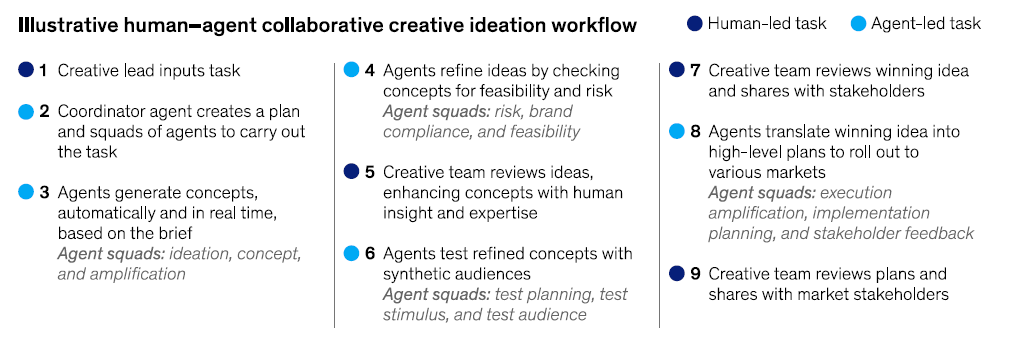
In their newly designed creative workflow, human marketers no longer write the first draft. Instead, a squad of agents instantly generates dozens of initial concepts, cross-checks them against legal risk guidelines, runs the simulated pre-tests, and builds the launch plan.
The human workers are elevated to the role of creative directors. They manage the agents, review the data-backed outputs, inject market intuition into the winning concepts, and align the final product with key stakeholders. The result? The brand can test ten times the number of creative concepts in parallel. Learning cycles accelerate dramatically, and marketers finally have the time to obsess over the ideas that actually move the needle.
Adding AI agents to the creative process can accelerate timelines while freeing human to propel creative excellence
Step 5: Prioritize in Waves (Don't Boil the Ocean)
Once your future-state workflows are mapped, you face a critical decision: what to launch first, and whether to build custom tools or buy off-the-shelf solutions.
The secret here is ruthless prioritization. You want to target areas with massive efficiency upside to secure quick wins, but your ambition must be anchored by technical reality. If your underlying data pipelines and metadata structures aren’t clean, you cannot automate the workflow. You have to wait until the plumbing is ready for agentic orchestration.
Let’s look at how our global consumer brand actually rolled this out. They didn’t flip a giant switch; they deployed their new workforce in three deliberate waves:
Wave 1: The Ideation Engine. They started with low-risk, high-reward tasks. Agents were deployed to continuously generate and refine campaign assets, feeding the human team an endless stream of fresh concepts to vet.
Wave 2: The Safety Net. Next, they layered on intelligence and guardrails. Agents began running rapid, simulated pre-tests on the creative concepts while autonomously flagging legal, brand, and risk compliance issues.
Wave 3: Global Scale. Finally, they unleashed the system worldwide. Agents took the approved core messages, adapted them for local dialects and cultural nuances, and coordinated the rollout across global regions.
The result? A clunky, manual marathon became a data-driven sprint. In their early pilots, the end-to-end production speed increased by a staggering 4x.
Beyond Content: Autonomous Media Execution
We are seeing this exact same phased approach revolutionize media buying.
Advanced advertising platforms are now deploying agents to autonomously optimize campaigns across major digital channels. These aren’t just dashboard alerts telling a human what to do; these agents are pulling the levers. They actively evaluate live performance, adjust bids, shift budgets, dynamically pair creative variants with micro-audiences, and generate new messaging on the fly.
They manage the thousands of real-time micro-adjustments that used to burn out entire teams of media buyers. Early adopters are reporting radically faster optimization cycles and a measurable, significant spike in Return on Ad Spend (ROAS).
This is what happens when you stop using AI as a brainstorming buddy and start treating it as an execution engine.
The Leadership Mandate (and the Risks)
Let’s be clear: transitioning to an agentic workflow is not a localized IT project. It is a fundamental operational shift that requires a top-down mandate from the CEO and the board.
While AI agents are the current stars of the show, do not throw out the rest of your technical toolkit. Traditional scripting, robotic process automation (RPA), and standard machine learning still have massive roles to play. If you focus exclusively on autonomous agents, you will leave serious efficiency gains on the table.
Then there is the risk. In marketing, a rogue AI doesn’t just crash a spreadsheet; it publicly damages your brand.
When we surveyed 35 CMOs at Fortune 250 companies, their anxieties were remarkably consistent. They aren’t worried about the AI being “too smart.” They are losing sleep over brand safety, legal liabilities, glaring talent gaps, and data bottlenecks. To sleep soundly, your insights teams must establish rigid confidence thresholds. You cannot let a machine inform a multi-million-dollar investment without a rock-solid validation process in place.
The 90/10 Trap
Right now, nearly 90% of CMOs are actively experimenting with AI. But look closer, and fewer than 10% are actually capturing tangible value across an end-to-end workflow. Most departments are stuck in pilot purgatory.
Agentic AI is the key to breaking out of that trap. But as we finally begin to deploy these systems at scale, every marketing leader has to confront an existential question: Are we simply becoming managers of complex algorithms, or does human creativity still hold the steering wheel?
The Bottom Line: Taste Cannot Be Automated
The answer isn’t replacement; it’s elevation.
The machines give us unprecedented precision, scale, and velocity. But algorithms do not have “taste.” They do not understand the cultural zeitgeist, they cannot read a room, and they do not feel empathy. Human-led insights and strategic judgment are more critical now than they were before the AI boom.
The true competitive advantage of the next decade won’t belong to the brand with the most AI agents. It will belong to the team that figures out how to seamlessly weave human intuition into the fabric of a machine-speed execution engine.